

 Thought Leadership
Navigating Turbulent Waters: The Complex and Costly Preparation of Costs and Case Management Conferences before Trial

28 Aug 2025
4 min read
This website will offer limited functionality in this browser. We only support the recent versions of major browsers like Chrome, Firefox, Safari, and Edge.
Thought Leadership
/Passle/5d9604688cb6230bac62c2d0/SearchServiceImages/2025-08-28-13-30-17-201-68b059e9f5555f205972cec7.jpg)


Parties have been reminded that they are under an obligation to actively explore alternative dispute resolution (James Churchill v Merthyr Tydfil County Borough Council [2023] EWCA Civ 1416) and conduct litigation collaboratively (OMV Petrom SA v Glencore International AG [2017] EWCA Civ 195). Of course, sometimes a settlement cannot be achieved early on and when pre-action correspondence does not seem to be leading to a resolution, it may be tempting to issue a claim (or, indeed, it may be your only option) in the hope that it prompts more fruitful settlement discussions before the parties incur the significant costs of evidence and a trial. However, when deciding whether to issue a claim, the complex and costly nature of the preparation required for a Costs and Case Management Conference (CCMC) – a Court hearing on procedure which can come well before trial – is often overlooked and underestimated and may not be the most efficient use of time and funds, particularly if your goal is to seek an early commercial resolution. This article provides more insight into the preparation required for a CCMC and why careful planning is necessary.
After serving the claim form and exchanging statements of case, the CCMC emerges as an important checkpoint for many cases on the multi-track before setting sail for trial. This is because that is when the Court sets the future timetable for the case, shaping its ultimate trajectory. The infographic below illustrates the relative costs incurred at each stage of case progression, showing that the Case Management stage not only carries a high cost in itself but also marks the beginning of subsequent resource-intensive phases.
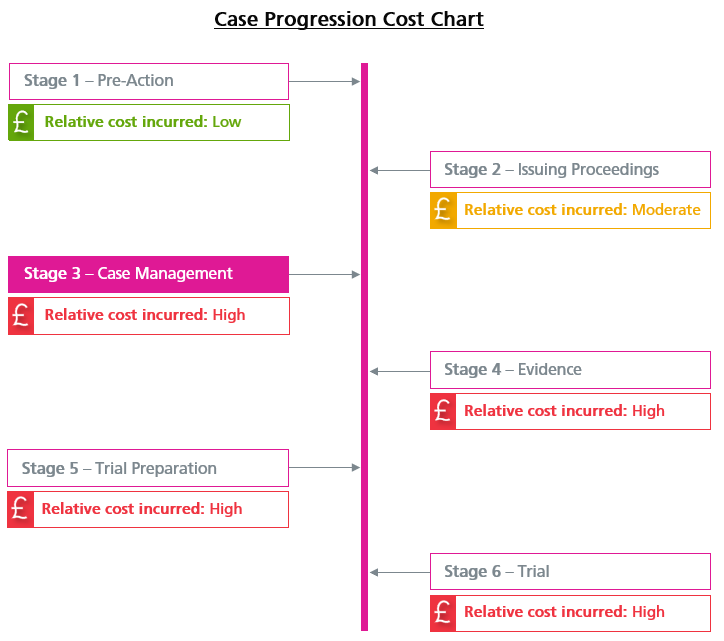
The CCMC involves significant work to prepare for and attend. A crucial step in preparing for a CCMC is creating a costs budget. For most cases, this budget details the anticipated costs of the claim up to and including trial, considering factors like expert witness requirements, trial duration and other costs. Crafting a comprehensive and realistic costs budget requires foresight and planning as parties aim to maximise recoverable costs while minimising risk exposure. However, navigating this process is far from simple. In most cases, the budget will need to be filed and exchanged weeks before the CCMC. In addition, parties scrutinise each other’s assumptions and costs estimates in a Costs Budget Discussion Report. Failure to file a costs budget results in serious consequences, as you may only be able to recover the applicable court fees even if your claim succeeds.
Where the CCMC is taking place in the Business and Property Courts and Extended Disclosure is required, a Disclosure Review Document will also need to be prepared. This comprises two parts:
Understanding the data universe is not a straightforward exercise as it necessarily includes every conceivable source of information that is relevant to the case. From instant messages on Microsoft Teams, Slack or WhatsApp to emails, the breadth of data requires a thorough assessment. Data is often collected at the start of this stage, which helps inform the approach to disclosure later on and assists solicitors during CCMC negotiations and risk assessment. It’s imperative to note that disclosure exercises can incur substantial costs, highlighting the importance of executing them efficiently.
Also, central to the issues to be determined at the CCMC are the Draft Directions. These detail the procedural steps leading up to trial, including when and how matters such as disclosure, witness statements, and expert evidence are to unfold. The negotiation process surrounding the draft directions often mirrors the underlying tensions of the case itself as parties must try to seek mutual agreement before the CCMC.
In conclusion, preparing for a successful CCMC requires navigating through a myriad of challenges. From drafting essential documents to engaging in strategic negotiations, the process demands legal expertise, foresight and negotiation skills. Parties must maintain balance and a willingness to compromise. Preparing for a CCMC is a complex and expensive task, and is a mandatory step in the litigation process once a claim is issued. Parties should think carefully before moving on from pre-action correspondence, and if the main aim is to achieve an early deal, settlement discussions and mediation should be prioritised wherever practicable to maximise the chance of a more favourable and cost-effective outcome.
If you have any questions or would otherwise like to discuss any of the issues raised in this article, please contact Simon Lellouche.
Parties should think carefully before moving on from pre-action correspondence, and if the main aim is to achieve an early deal, settlement discussions and mediation should be prioritised wherever practicable to maximise the chance of a more favourable and cost-effective outcome.
 Thought leadership
28 September 2026

Thought leadership
16 September 2026
/Passle/5d9604688cb6230bac62c2d0/SearchServiceImages/2026-09-16-13-56-55-330-6aaaa0277131791624e8f6e1.jpg)
/Passle/5d9604688cb6230bac62c2d0/SearchServiceImages/2026-09-16-09-24-43-010-6aaa605bf276fb0829671d6c.jpg)
Thought leadership
8 September 2026
/Passle/5d9604688cb6230bac62c2d0/SearchServiceImages/2026-09-08-09-01-43-688-6a9fcef75357362d682db950.jpg)
Legal updates
3 September 2026

Thought leadership
25 August 2026

Thought leadership
24 August 2026
/Passle/5d9604688cb6230bac62c2d0/SearchServiceImages/2026-08-13-22-01-25-554-6a7e3eb59e1afd4e257e5d99.jpg)

Thought leadership
18 August 2026
/Passle/5d9604688cb6230bac62c2d0/SearchServiceImages/2026-08-18-22-00-15-019-6a84d5efd70ebdca3f334cc0.jpg)
Thought leadership
18 August 2026
/Passle/5d9604688cb6230bac62c2d0/SearchServiceImages/2026-08-18-21-37-46-426-6a84d0aaa91bafca133025a9.jpg)
Want more Burges Salmon content? Add us as a preferred source on Google to your favourites list for content and news you can trust.
Update your preferred sourcesBe sure to follow us on LinkedIn and stay up to date with all the latest from Burges Salmon.
Follow us