

 Thought Leadership
Pension Under Saving in the UK: the EDI perspective on the Second Pensions Commission’s Interim Report

2 Sep 2026
6 min read
This website will offer limited functionality in this browser. We only support the recent versions of major browsers like Chrome, Firefox, Safari, and Edge.
Thought Leadership
/Passle/5d9604688cb6230bac62c2d0/SearchServiceImages/2026-09-02-11-09-08-138-6a9803d48c3102bcdcd4cdd3.jpg)


With recent research revealing that structural barriers continue to leave women, carers, disabled people, ethnic minority groups and the self-employed at a persistent disadvantage, this article explores the practical steps trustees, pension providers and employers can take now to address fairness and equality concerns in pension saving.
As we highlighted in our recent article, the Second Pensions Commission has released an interim report (the “Interim Report”) looking at the current state of retirement savings in the UK. Alongside that report, the DWP published a supplementary paper (the “Supplementary Paper”) on life courses and pension saving patterns.
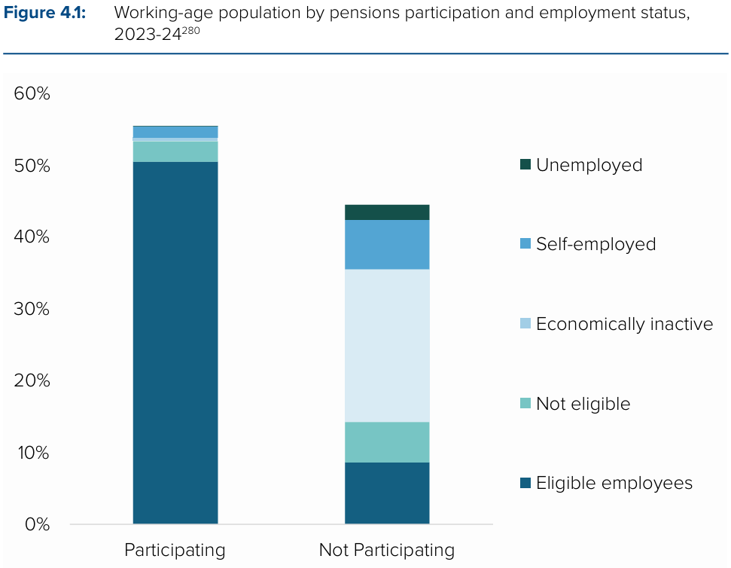
The Interim Report notes that whilst automatic enrolment and the new State Pension strengthened the UK pension system, weaker defined benefit coverage, more complex retirement decisions, lower home ownership and other factors have meant that around 4 in 10 working-age people—about 15 million—are under saving for retirement against target replacement rates.
Using the intelligence gathered in the Interim Report about the current UK pensions landscape, the Second Pension Commission has now moved into the next phase of its work, as it seeks to formulate its recommendations for designing a pensions system that will provide adequate, fair and sustainable retirement incomes. Whilst our first article focused on the adequacy question and the role of employers, here we hone in on what the report’s findings tell us about fairness. We consider steps that employers, pension providers and trustees could take now and in future with a view to addressing some of the EDI challenges the Interim Report and Supplementary Paper identify.
The report also highlights the need for greater focus on protected default decumulation frameworks since the risks of eating into pension wealth from full cash withdrawals, tax-free lump sums and high withdrawal rates have significantly increased since the 2014 pension access reforms.
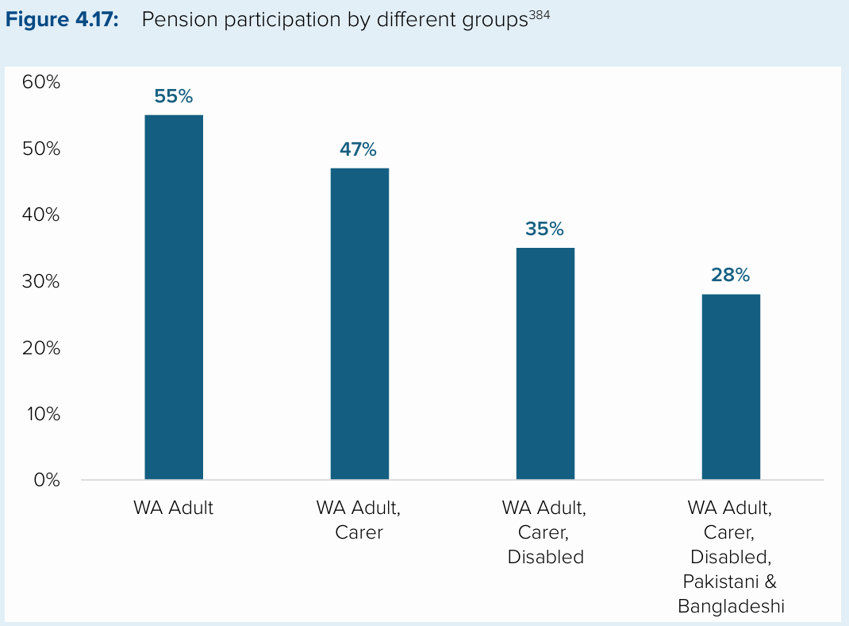
As noted by the report, these “disparities accumulate across the life course” and compound where characteristics overlap: working-age adults who are Pakistani or Bangladeshi, disabled and providing care are roughly half as likely to participate in pension saving compared to the average working-age adult. [see figure 4.17]
The Supplementary Paper reinforces that some participation gaps have been addressed since the enactment of automatic enrolment but that inequalities in labour market patterns continue to create a disparity.
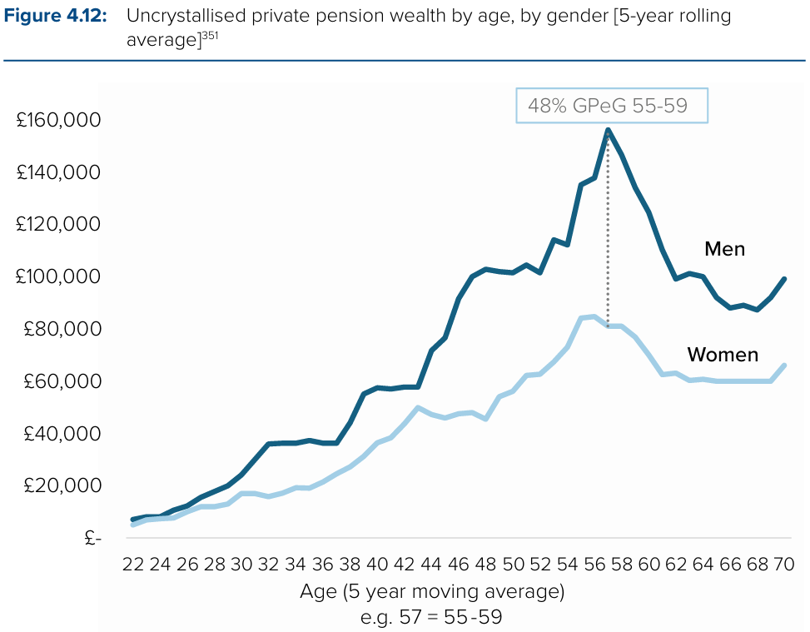
An example of this disparity can be seen through life events and whilst there is a limited effect on pension participation and contribution rates, there appears to be a clear impact on private pension savings between men and women. This inequality can often be masked through partner income but with the potential for divorce, separation or bereavement, this issue can leave women exposed to lower later-life resources.
The Supplementary Paper further notes that sustained part-time work and periods of non-employment are more common among women, particularly ethnic minority women, and among people reporting disability in later working life. These patterns help explain the persistent EDI gaps in pension saving that automatic enrolment alone cannot eliminate whilst labour-market inequalities remain.
From the report there are a number of practical points trustees can take away to seek to address pensions adequacy and fairness concerns:
Trustees should consider decumulation support and defaults, especially for smaller pots and more vulnerable members. From 2029, some Trustees will be under a legal retirement to design and offer one or more ‘default pension benefit solutions’ to support members by nominating a default decumulation product or solution that they will be automatically offered at retirement.
From the report there are also a number of practical points employers can take away to address pensions adequacy and fairness:
For trustees and employers, the key message is that pension adequacy and fairness should be considered alongside broader workforce, equality and governance issues. A more inclusive approach to scheme design, communications and retirement support will be increasingly important as pension policy continues to evolve.
Please contact Mamunul Wahid, Alice Honeywill or your usual Burges Salmon contact if you would like to explore how we can assist.
Written by Mamunul Wahid and Christian Wade
 Thought leadership
13 October 2026
/Passle/5d9604688cb6230bac62c2d0/SearchServiceImages/2026-10-12-14-14-33-342-6acceb493a2af61876049e13.jpg)
Thought leadership
5 October 2026

Thought leadership
1 October 2026
/Passle/5d9604688cb6230bac62c2d0/SearchServiceImages/2026-10-01-13-35-42-954-6abe61ae780876d3b97fb000.jpg)
Thought leadership
29 September 2026
/Passle/5d9604688cb6230bac62c2d0/SearchServiceImages/2026-09-29-13-53-17-398-6abbc2cd155f6f59c63a6ccb.jpg)
Thought leadership
24 September 2026
/Passle/5d9604688cb6230bac62c2d0/SearchServiceImages/2026-09-24-13-46-41-982-6ab529c1240c5cc53a60182a.jpg)
/Passle/5d9604688cb6230bac62c2d0/SearchServiceImages/2026-09-08-07-23-48-748-6a9fb8046b5927386a336f57.jpg)
Thought leadership
7 September 2026
/Passle/5d9604688cb6230bac62c2d0/SearchServiceImages/2026-09-07-17-20-00-533-6a9ef240ed7d1242d376de3e.jpg)
Thought leadership
3 September 2026
/Passle/5d9604688cb6230bac62c2d0/SearchServiceImages/2026-08-27-07-55-59-900-6a8fed8f9f47d1c63b4ea2f3.jpg)
/Passle/5d9604688cb6230bac62c2d0/MediaLibrary/Images/5f37f1285354880c64118596/2021-10-27-13-53-14-163-617959ca17af5b0b6cfc61cc.jpg)
Thought leadership
24 August 2026
/Passle/5d9604688cb6230bac62c2d0/SearchServiceImages/2026-08-24-12-22-54-763-6a8c379eb4553f6e28c0571c.jpg)
Want more Burges Salmon content? Add us as a preferred source on Google to your favourites list for content and news you can trust.
Update your preferred sourcesBe sure to follow us on LinkedIn and stay up to date with all the latest from Burges Salmon.
Follow us