

 Thought Leadership
Suspension Upheld: Why all procurement professionals should be looking at Parkingeye Limited v Velindre

5 May 2026
6 min read
This website will offer limited functionality in this browser. We only support the recent versions of major browsers like Chrome, Firefox, Safari, and Edge.
Thought Leadership
/Passle/5d9604688cb6230bac62c2d0/SearchServiceImages/2026-05-01-16-15-19-854-69f4d197bf7c5aa068a12e5f.jpg)


Summary
On 1 May 2026, the Court handed down its first ever judgment on ‘suspension lifting’ under the Procurement Act 2023 (the “Act”). Parkingeye Limited v Velindre University NHS Trust & Anor [2026] EWHC 1019 (TCC)
The Court stated that “the new test is intended to be substantively and not merely formally very different, in both its method and its effect, from the former test”, and then went on to analyse each factor in the new test and how it is different from the previous test. The new test under section 102(2) of the Procurement Act is here.
The insights offered by this first judgment into the new method and effect of the test will be essential reading for all those considering the prospects that an ‘automatic suspension’ under the Act may be upheld or lifted, including for:
Under the Procurement Act 2023, where a Claim is commenced at Court and notified during the ‘standstill period’, it triggers an ‘automatic suspension’ under the Act, suspending the contracting authority’s (i.e. the buyer’s) ability to enter into the contract with the preferred bidder.
The automatic suspension exists as a mechanism to pause the procurement outcome to give the Court a chance to review the legality of the award, if needed, before the contract is signed. It is an automatic interim remedy for a bidder pending a hearing to lift the suspension and an expedited or normal trial (if the suspension remains in place and the bidder is willing to give a cross undertaking in damages). Once the contracting authority enters into the contract with the preferred bidder, the Claimant’s primary (albeit not only remedy) is damages, meaning the automatic suspension is an important remedy in procurement cases.
If the contracting authority wishes to proceed to enter into the contract then it needs to apply to Court to ‘lift’ the automatic suspension. The same process of ‘automatic suspension’ and ‘lifting applications’ existed under the old legal regimes preceding the Act. However, the Act creates a new test for the Court to apply when hearing applications to lift the suspension by contracting authorities. The old test was differently worded. As such, a much-debated question has been whether the new suspension lifting test in Section 102(2) of the Act would be interpreted differently by the Court and, if so, whether it might result in a shift in approach & outcomes.
A particular reason why this matters is that, as the Court observed in this case, under the old test “it was relatively difficult for a claimant to successfully resist an application to lift the stay” – i.e. in most cases the suspension was lifted; the contract could be entered into; and the Claimant was left with damages as their primary remedy.
The Parkingeye case suggests the Court will approach the new test differently.
Summary of why the new test is different
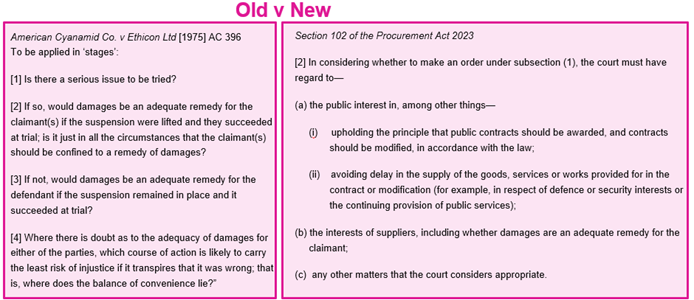
In this judgment, the Court (HHJ Keyser KC):
[1] stated that “the new test is intended to be substantively and not merely formally very different, in both its method and its effect, from the former test”
[2] Explained why the test was different in both method and effect, in particular because:
In his concluding remarks the Judge said:
“In my judgment, the statutory suspension and the new test for applications to lift the suspension are clearly intended to ensure that proper weight is given to the public interest in ensuring that public contracts are awarded in accordance with the law and that, accordingly, the courts do not too lightly lift the suspensions. I have explained above how I consider this is achieved, if section 102(2) is construed appropriately.”
Comment
Importantly, and for the first time in a suspension lifting application, this new interpretation and weighting of the ‘public interest’ factor ‘won the day’. The suspension was not lifted, even though the Court considered (amongst other factors) that damages would likely have been an adequate remedy; a factor which is normally determinative in resulting in the suspension being lifted (under the old law). This was because:
“I see nothing in the facts of the present case that provides sufficient reason, in respect either of any other aspect of the public interest or of the private interests of third parties, to outweigh the public interest to which the suspension is intended to give effect. Accordingly, I shall refuse the applications to lift the suspension. I consider it appropriate to exact an undertaking in damages from the respondent, which ought to be in the form found in the standard orders for interim injunctions.”
This is the first suspension case under the Act and suggests the Courts view the new test as different to the old law. Whilst every case will be fact specific (given the public interest and interests of supplier considerations will likely be different in every case), the case suggests outcomes may be different to the old law at automatic suspension hearings and Courts may be more willing than previously to keep suspensions in place pending trial.
----------------------------------------
This article was written by Richard Binns and Lloyd Nail in Burges Salmon’s Public Procurement team.
For more information about the Procurement Act or to join our Procurement mailing list visit Burges Salmon P.A.T.H. (Procurement Act Training and Help) - Burges Salmon
This is the first suspension case under the Act and suggests the Courts view the new test as different to the old law.
 Thought leadership
3 September 2026
/Passle/5d9604688cb6230bac62c2d0/SearchServiceImages/2026-09-01-08-17-53-210-6a968a315b49dbc4a9b8d96c.jpg)
Thought leadership
17 August 2026
/Passle/5d9604688cb6230bac62c2d0/SearchServiceImages/2026-08-17-10-55-37-033-6a82e8a98f6deb11a13873e8.jpg)
Thought leadership
17 August 2026
/Passle/5d9604688cb6230bac62c2d0/SearchServiceImages/2026-08-17-06-43-56-505-6a82adac112907c43e547a51.jpg)
Thought leadership
17 August 2026
/Passle/5d9604688cb6230bac62c2d0/SearchServiceImages/2026-08-17-12-49-11-457-6a8303477533d54440c5b4d4.jpg)
Thought leadership
31 July 2026
/Passle/5d9604688cb6230bac62c2d0/SearchServiceImages/2026-07-31-15-07-49-657-6a6cba4551520cedf2d68f10.jpg)
/Passle/5d9604688cb6230bac62c2d0/SearchServiceImages/2026-07-30-17-42-42-066-6a6b8d12e94c938b93bf2d40.jpg)
Legal updates
29 July 2026
/Passle/5d9604688cb6230bac62c2d0/SearchServiceImages/2026-07-29-11-52-45-213-6a69e98ddc37b04dfb50de19.jpg)
Thought leadership
21 July 2026
/Passle/5d9604688cb6230bac62c2d0/SearchServiceImages/2026-07-21-14-52-58-564-6a5f87ca04566971c880527c.jpg)
Thought leadership
8 July 2026
/Passle/5d9604688cb6230bac62c2d0/SearchServiceImages/2026-07-08-16-00-09-024-6a4e74099e413e7e9ffc9a71.jpg)
Want more Burges Salmon content? Add us as a preferred source on Google to your favourites list for content and news you can trust.
Update your preferred sourcesBe sure to follow us on LinkedIn and stay up to date with all the latest from Burges Salmon.
Follow us