

 Thought Leadership
CATO update March 2026: What you need to know about recent developments

24 Mar 2026
8 min read
This website will offer limited functionality in this browser. We only support the recent versions of major browsers like Chrome, Firefox, Safari, and Edge.
Thought Leadership
/Passle/5d9604688cb6230bac62c2d0/SearchServiceImages/2026-03-24-17-22-12-868-69c2c8449a4a5774cbfe37f5.jpg)


It has been a busy couple of weeks in the world of the Competitively Appointed Transmission Owner (CATO) regime, with the National Energy System Operator (NESO) publishing a number of documents and hosting a webinar covering recent updates. This article summarises recent developments to be aware of, and provides a recap on certain aspects of the regime.
Expression of Interest Request
The National Energy System Operator (NESO) has published an Expression of Interest (EoI) relating to the proposed early competition model for CATOs. This marks a further material step in the introduction of competitive tendering processes in onshore electricity transmission, moving the regime from legislative design into practical engagement with the market.
The EoI follows several years of policy development and regulatory groundwork, including the enactment of the Energy Act 2023, the coming into force of the Criteria Regulations in March 2024 and the approval of the Early‑Model CATO Tender Regulations in April 2025. Together, these measures establish the framework under which certain onshore transmission assets may be delivered through competitive tendering rather than by the incumbent transmission owners.
Context: policy to implementation
As we noted in our 2024 update on competition in onshore electricity transmission, policy intent to introduce CATOs has existed for over a decade, but progress was incremental for much of that period. Momentum accelerated following the Government’s Transmission Acceleration Action Plan in November 2023 and the subsequent establishment of the legislative framework under the Energy Act 2023.
The approval of the Early‑Model CATO Tender Regulations in April 2025 provided clarity on the mechanics of competitive tendering and licence award. NESO’s EoI now sits squarely within this implementation phase, reflecting NESO’s intention to identify the first project to be recommended to Ofgem for the CATO regime by the end of 2026, along with a subsequent pipeline of projects through to 2028.
What NESO is seeking to understand
Through the EoI, NESO is undertaking a market sounding exercise seeking feedback from a broad range of market participants, including developers, contractors, investors, lenders and existing network operators. In particular, the market sounding is intended to help NESO understand:
The EoI represents an ability for the market to influence how the CATO regime operates in practice. Whilst there have been doubters over the last decade as to whether the CATO regime would ever be given an opportunity to spread its wings, this is the opportunity for the industry to indicate its appetite to deliver under the regulatory framework that has been created. Whether the CATO regime quickly becomes a significant feature in the expansion and reinforcement of the GB transmission system, or just an interesting side show, will ultimately depend on (i) whether the risk and reward profile created by the regime is seen as attractive enough to drive interest from those who are considering the opportunity, and (ii) whether in practice successful bidders are able to deliver projects expeditiously and in a manner which achieves costs savings to the consumer.
Responses to the EoI will be treated as commercially confidential. The aggregated responses will feed into NESO’s project identification process which will then form the basis of its engagement with Ofgem in respect of:
NESO has emphasised that the EoI is not a request for bids, nor does it form part of any formal pre‑qualification or tender process. Instead, it is a non‑binding market-sounding exercise, intended to inform NESO’s approach to early competition by testing market appetite, capacity and capability ahead of the identification and sequencing of potential CATO projects.
Reminder of the key CATO commercial features
The EoI summarises the key commercial features of the CATO regime, which by way of recap, are repeated below:
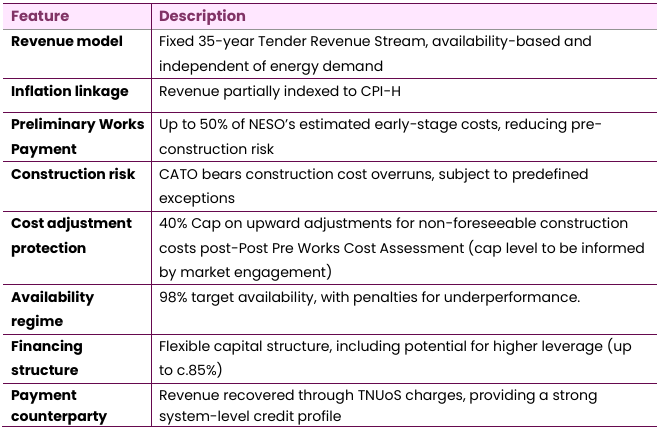
Whilst some of the features of the regime bear a resemblance to the OFTO regime, the delivery risk profile is obviously fundamentally different. This will not involve a built and commissioned asset changing hands, but a complex design, consenting and delivery challenge to be solved by the successful bidder.
Identification of Projects – appraisal methodology published
NESO has also recently published a Project Appraisal Methodology for stakeholder feedback explaining how NESO will identify the first, and the subsequent pipeline of onshore transmission projects that are suitable for early competition. The proposal sets out a structured seven-step appraisal method aligned to the Electricity (Criteria for Relevant Electricity Projects) (Transmission) Regulations 2024 (Criteria Regulations). As a reminder, the Criteria Regulations require a project to be:
Using the proposed methodology, NESO intends to review the transmission reinforcement projects recommended in the Transitional Centralised Strategic Network Plan 2 Refresh (tCSNP2 Refresh) (expected to be completed by 30 June 2026) to determine which may be suitable for delivery via the early competition model and can therefore be identified as potential CATO projects. Factors such as cost-benefit analysis, certainty of need, high-level design certainty and environmental/construction risks will help NESO to shortlist and prioritise projects for recommendation. NESO is seeking feedback on its proposed project appraisal methodology and may amend the methodology in response to feedback.
Prequalification and ITT Criteria
Significantly, NESO has also published its Pre-qualification Questionnaire and ITT Questions, which provide further detail on the requirements that bidders will need to meet once a project has been approved by Ofgem for the CATO early competition model.
The consortia interested in bidding for the right to deliver the relevant transmission assets will need, as part of the pre-qualification process, to demonstrate not only their financial standing and ability to raise finance, but also their technical ability, through:
In putting together a consortium with the best chance of success, participants will also wish to be asking similar questions of their professional advisors and consultancies, to ensure they have appropriate expertise available not only to assist with their bids, but to actually help deliver a complex linear project from inception, through consenting, development and construction.
Why this matters for the market
Under the CATO model, a competitively selected entity would be licensed to design, finance, construct, own and operate defined onshore transmission assets, receiving a long‑term, availability‑based, inflation‑linked revenue stream. While assets remain part of the national transmission system and subject to regulatory oversight, delivery responsibility shifts away from the incumbent transmission owners.
For investors and developers, this creates a new regulated infrastructure asset class, with characteristics likely to be familiar to participants in the OFTO regime, but with important differences in timing, risk profile and delivery scope. Equity investors, major construction contractors/EPCs and strategic utilities may all see opportunities to participate, either directly or through consortium structures combining capital, construction and operational expertise.
The EoI and appraisal methodology also matter for the shape of the future project pipeline. NESO has indicated that responses to both will help inform how quickly and at what scale early competitions can be launched, as well as how projects should be structured and how they are chosen to ensure the pipeline remains attractive for market participants while delivering value for consumers.
Key points for prospective respondents
While response to the EoI or appraisal methodology do not require pricing or binding commitments, it is not without strategic significance. Participants may wish to consider:
There is no evident downside to engagement at this stage, given the non‑binding nature of the exercises. There is also potentially significant upside in helping to shape a regime that could play a major role in the delivery of new transmission infrastructure.
Looking ahead
The deadline for submitting responses to the EoI is 30 April 2026. Following the EoI process, in Q2 2026 NESO intends to analyse the responses and prepare aggregated market intelligence, and use this to inform its engagement with Ofgem regarding competition design, project identification and market capability, as mentioned above.
There is no specified deadline for stakeholder feedback on the appraisal methodology, so respondents may want to consider the issues raised by the EoI and/or appraisal methodology in tandem or sequentially.
The documents published by NESO represents a bridge between the legislative framework now in force and the identification of the first tranche of projects suitable for competitive delivery by the end of 2026. For those with an interest in onshore transmission investment or major infrastructure delivery, NESO has issued a clear signal that early competition is moving from concept to reality. Market participants who wish to influence how that reality takes shape should consider engaging with the documents published to date.
This article was written by James Phillips (Partner) and Imogen Drummond (Solicitor)
Whilst there have been doubters over the last decade as to whether the CATO regime would ever be given an opportunity to spread its wings, this is the opportunity for the industry to indicate its appetite to deliver under the regulatory framework that has been created.
 Thought leadership
7 October 2026
/Passle/5d9604688cb6230bac62c2d0/SearchServiceImages/2026-10-07-13-24-03-610-6ac647f33724c91c5285c5bc.jpg)
Legal updates
1 October 2026

Thought leadership
1 October 2026
/Passle/5d9604688cb6230bac62c2d0/SearchServiceImages/2026-09-17-16-44-01-145-6aac18d13163f6587eb96e08.jpg)
Thought leadership
22 September 2026
/Passle/5d9604688cb6230bac62c2d0/SearchServiceImages/2026-09-22-12-58-29-767-6ab27b750e64863551deb684.jpg)

Legal updates
18 September 2026


Thought leadership
11 September 2026
/Passle/5d9604688cb6230bac62c2d0/SearchServiceImages/2026-09-11-15-37-34-289-6aa4203e68316c73ea5a2624.jpg)
Thought leadership
4 September 2026
/Passle/5d9604688cb6230bac62c2d0/SearchServiceImages/2026-09-04-10-41-42-841-6a9aa0669a3310b0baa411fa.jpg)
Thought leadership
1 September 2026
/Passle/5d9604688cb6230bac62c2d0/SearchServiceImages/2026-09-01-13-43-13-742-6a96d671732736ae47c63a04.jpg)
Want more Burges Salmon content? Add us as a preferred source on Google to your favourites list for content and news you can trust.
Update your preferred sourcesBe sure to follow us on LinkedIn and stay up to date with all the latest from Burges Salmon.
Follow us