

 Thought Leadership
The Renters’ Rights Act 2025: Prior Notice

30 Mar 2026
5 min read
This website will offer limited functionality in this browser. We only support the recent versions of major browsers like Chrome, Firefox, Safari, and Edge.
Thought Leadership
/Passle/5d9604688cb6230bac62c2d0/SearchServiceImages/2026-03-29-18-42-06-229-69c9727e8d1cbb68e12e2d88.jpg)


Our guide to the Renters' Rights Act 2025 can be downloaded for free: The Renters' Rights Act 2025
Our webinar on the Renters' Rights Act 2025 can be watched here: Renters Rights Act 2025 - what you need to know.
Our hub bringing together all of our Renters' Rights Act 2025 material is here: The Renters’ Rights Act 2025 hub
This is a deeper dive into the new obligations on landlords to provide Prior Notice to tenants of certain circumstances where the landlord might want to recover possession of the property.
From 1 May 2026 landlords under the Renters' Rights act 2025 will need to give their tenants Prior Notice that a particular ground for possession may be relied upon. If no Prior Notice is given and the landlord later relies upon that ground for possession of the property, then the landlord could face an initial fine of up to £7,000.
This requirement also applies to some existing tenancies.
A number of the Prior Notice grounds relate to a situation where a landlord lets the property to a tenant, who then goes on to let some or all of that property to another tenant. Here’s a guide to the terminology:
| Term | Definition | 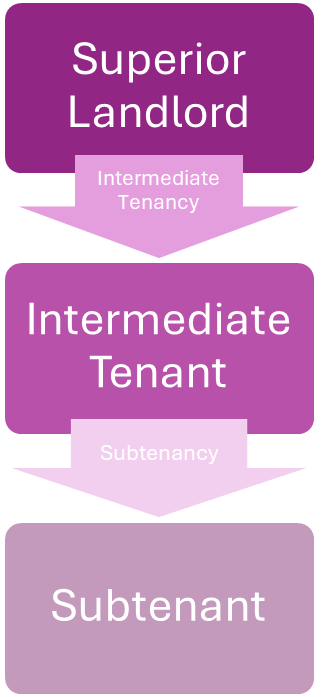 |
| Superior Landlord | Owns the property and has granted a tenancy to the Intermediate Tenant. | |
| Intermediate Tenancy | The tenancy between the Superior Landlord and the Intermediate Tenant. | |
| Intermediate Tenant | The tenant of the Intermediate Tenancy The Intermediate Tenant then sublets either whole or part of the property to a Sub-tenant. | |
| Sub-tenancy | The tenancy between the Intermediate Tenant and the Sub-tenant. | |
| Sub-tenant | The tenant of the Sub-tenancy. The Intermediate Tenant is the Sub-tenant’s landlord. There is no direct relationship between the Sub-tenant and the Superior Landlord. |
The Renters Rights Act 2025 requires landlords to give Prior Notice to their tenants that the landlord may rely upon certain grounds for possession.
This existed for some grounds previously, but was not an issue in the era of section 21 notices.
Under the new rules, the grounds for possession relevant to a private landlord (not a social landlord) that require prior notice are
Where the landlord requires the property to house an agricultural employee.
These are the Prior Notice grounds from 1 May 2026 (excluding social housing grounds):
Grnd | Description |
2ZA | To be used by an Intermediate Tenant under an agricultural tenancy only to bring a Sub-tenancy to an end where the Superior Landlord has given notice to terminate the Intermediate Tenancy, and the Intermediate Tenancy will end within a period of 12 months. |
2ZB | To be used by an Intermediate Tenant to bring a Sub-tenancy to an end where the Intermediate Tenancy was granted for a fixed term of more than 21 years, and the term is due to expire within 12 months, or the Intermediate Tenancy has continued beyond the expiry of its fixed term, and the Superior Landlord has given notice to terminate it within the next 12 months |
2ZC | To be used by a Superior Landlord where the Intermediate Tenancy has come to an end, and the Superior Landlord has become the direct landlord of the Sub-tenant who has remained in occupation of the property. A claim for possession relying upon this ground must be commenced within 6 months from when the Superior Landlord became the direct landlord of the Sub-tenancy. |
2ZD | Similar to Ground 2ZC, but the Superior Landlord seeking possession became the direct landlord of the Sub-tenancy within the last 6 months under Section 18 of the Housing Act 1988 following the expiry of a fixed term tenancy of more than 21 years |
4A | To be used by a landlord of an HMO property let to full time students, if the notice is to expire between 1 June and 30 September (ie the academic vacation) and the property is going to be re-let to a new group of full time students. |
5A | To be used where the landlord requires the property to house an agricultural worker |
5C | To be used where the landlord employed the tenant and is seeking possession as their employment has come to an end |
The new Prior Notice rules will apply to some existing tenancies and all new tenancies from 1 May 2026.
For our deeper dive on the Information Sheet and Written Statement, which includes suggestions as to how to deal with these in practice, see: The Renters' Rights Act 2025 - the new requirement to provide an Information Sheet or Written Statement - Burges Salmon
For details of the content of the Information Sheet and the Written Statement see: The Renters' Rights Act 2025 - Information Sheets and Written Statements published with a deadline: 31 May 2026 - Burges Salmon
If the landlord fails to give Prior Notice and later relies upon one of the grounds for possession, then this should not prevent the landlord from obtaining possession but fines can be imposed of up to a maximum of £7,000 for the first breach.
Written with Ryan Small and Lucy Mostyn
This is a complex area and now is the time to be getting to grips with the new rules and their implications.
/Passle/5d9604688cb6230bac62c2d0/SearchServiceImages/2026-10-02-16-15-17-647-6abfd895f42906e03e5c84da.jpg)
 Legal updates
1 October 2026

Podcasts
1 October 2026 • 10 min read

/Passle/5d9604688cb6230bac62c2d0/SearchServiceImages/2026-09-29-16-13-19-636-6abbe39f460fb9469a259fed.jpg)
Thought leadership
28 September 2026

Thought leadership
24 September 2026
/Passle/5d9604688cb6230bac62c2d0/SearchServiceImages/2026-09-24-11-37-38-693-6ab50b82d87dc86f2a6a0cbb.jpg)
/Passle/5d9604688cb6230bac62c2d0/SearchServiceImages/2026-09-21-08-50-38-767-6ab0efdeff282ca5b388e346.jpg)
Thought leadership
17 September 2026
/Passle/5d9604688cb6230bac62c2d0/SearchServiceImages/2026-09-17-11-35-47-985-6aabd0933163f6587eb86c43.jpg)
/Passle/5d9604688cb6230bac62c2d0/SearchServiceImages/2026-09-17-11-22-53-614-6aabcd8d4a11247c3619743d.jpg)
Legal updates
9 September 2026

Want more Burges Salmon content? Add us as a preferred source on Google to your favourites list for content and news you can trust.
Update your preferred sourcesBe sure to follow us on LinkedIn and stay up to date with all the latest from Burges Salmon.
Follow us