

 Legal updates
Public Sector High Court Litigation in 2026: Key trends from 2014-2025

6 May 2026
11 min read
This website will offer limited functionality in this browser. We only support the recent versions of major browsers like Chrome, Firefox, Safari, and Edge.
Legal updates



Burges Salmon’s expert Public Sector Litigation team continues to collaborate with market-leading data analysis platform Solomonic to analyse over 8550 claims involving more than 1291 public sector parties, providing a unique insight into Public Sector High Court litigation.
The report offers valuable insights into the dynamics of public sector litigation, including:
Our collaboration with Solomonic continues to help us leverage data analytics to have more informed discussions with clients about individual cases, prepare case strategy, and effective case management.
In-house counsel may wish to consider:
Public Sector High Court litigation and Judicial Reviews have generally tracked each other over the last 11 years. Both were following a slight downward trend since 2014.
However, in 2025, Public Sector High Court litigation has risen alongside other High Court litigation, and Civil Judicial Reviews. At the same time Criminal Judicial Reviews have remained flat.
It’s not clear what is driving these changes. The similarity across civil disputes suggests that litigation activity may reflect macroeconomic conditions.
This shows that those in the public sector are not immune to a generally more litigious environment. However, as shown in the following analysis, where this activity occurs will vary.

The increase in activity in Public Sector High Court litigation in 2025, from 554 cases in 2024 to 855 cases in 2025 (54% increase), was largely due to an increase in number of claims against Central Government, Local Authorities and ALBs. In contrast, claims against Public Services and Regulators remained relatively steady, consistent since 2019.
The number of claims brought by the Public Sector has also increased, from 121 in 2024 to 141 in 2025 (16% increase). This is a relatively small increase compared to claims brought against the Public Sector.
The data shows that this increase in claimant activity was seen across the Public Sector, except for Local Authorities which saw a decrease in claims brought by them overall.
Whilst overall litigation activity has increased notably in 2025 compared to 2024, the data shows that the impact is not spread evenly and is focussed more on claims where ALBs, local and central government are the defendants.
There may be an effect of claims against Public Sector bodies returning to levels last seen pre-Covid.
Public Sector organisations need to be able to deal with a growing and evolving case load, potentially shifting from claimant to defendant work, anticipating the types of issues they need to be prepared to deal with.


The sectors and types of disputes involved in Public Sector High Court Litigation in 2025 are similar to those seen across the last 10 years.
In 2025, key sectors for claimants in cases where the public sector organisation was the defendant included real estate, technology, professional services, finance, and construction. The main types of disputes included alleged breach of statutory duty, procurement disputes, breach of contract, human rights, and negligence disputes.
Public Sector organisations need to be ready for the legal and factual matters in their disputes, having the right internal capabilities and external counsel.
They also need to be able to anticipate which types of work or counterparties may present greater litigation risk, requiring careful legal risk management. Public Sector organisations can build upon previous experience but need to keep an eye to the future.
It is difficult to identify comprehensively whether cases have settled. If there is no positive indication on the court file, Solomonic presumes that there has been settlement if a court action (which has been acknowledged or for which a Defence has been filed) has not had any activity for one year or longer. In a small number of cases this presumption may not be correct, for example, where a claim is stayed pending the outcome of another dispute. However, it is clear when a case reaches judgment.
We can see that, overall, cases involving Public Sector as claimants settle (or otherwise do not reach judgment) on average less than in all other claims. There is variation between the averages for different public sector sub-groups.
In contrast, where public sector organisations are defendants, they settle more on average than when they are a claimant. Notably, where Central Government, Local Authorities, and Public Services are defendants, settlement rates are around the same, and sometimes higher than the average settlement rates for all other High Court litigation.
It is also notable that there are few claims formally withdrawn overall, suggesting that almost all claims brought by or against public sector organisations reach settlement or judgment.
Sometimes cases are unlikely to settle, for example, because they are brought to help establish precedent. However, the data shows that most cases, whether in the Public Sector or more broadly, settle.
This impacts case strategy and the need to consider from the outset the likelihood of settlement and what can be done to improve chances of settlement, whilst keeping the costs and time of conducting the litigation reasonable and proportionate.


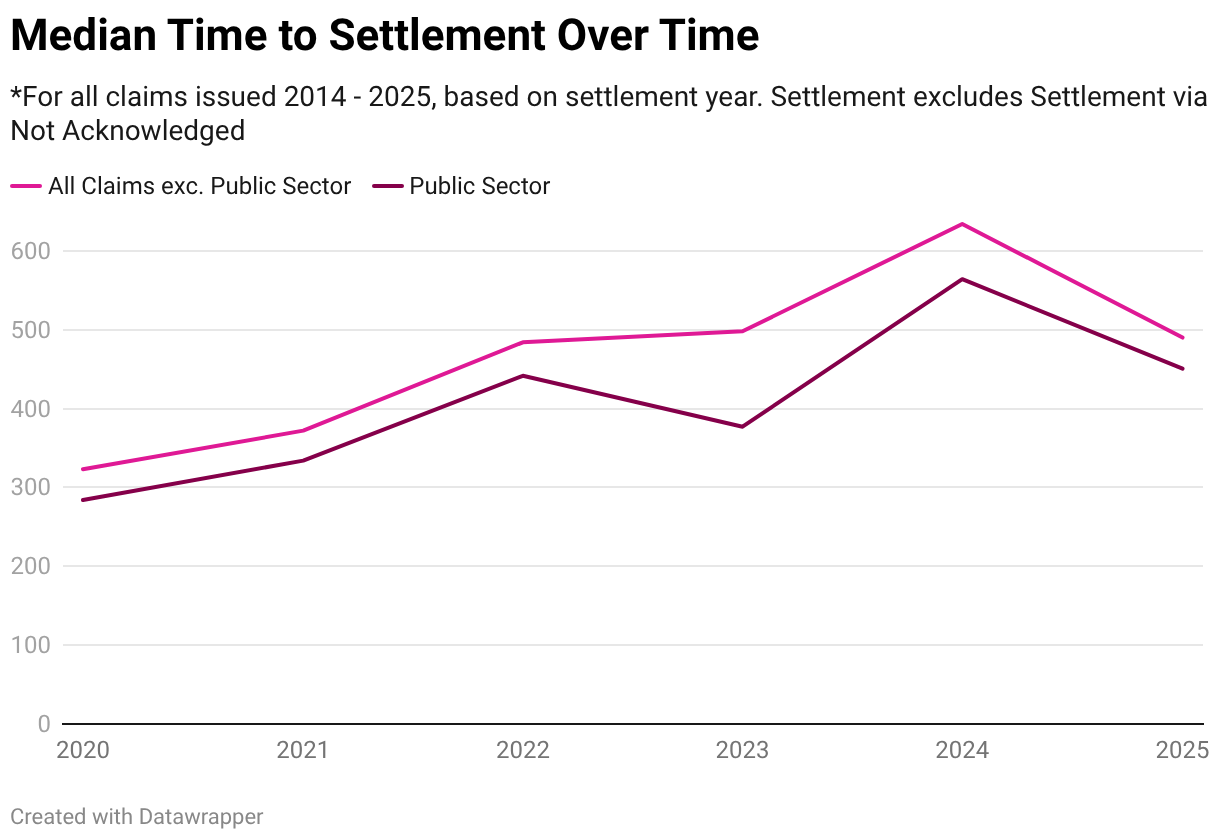
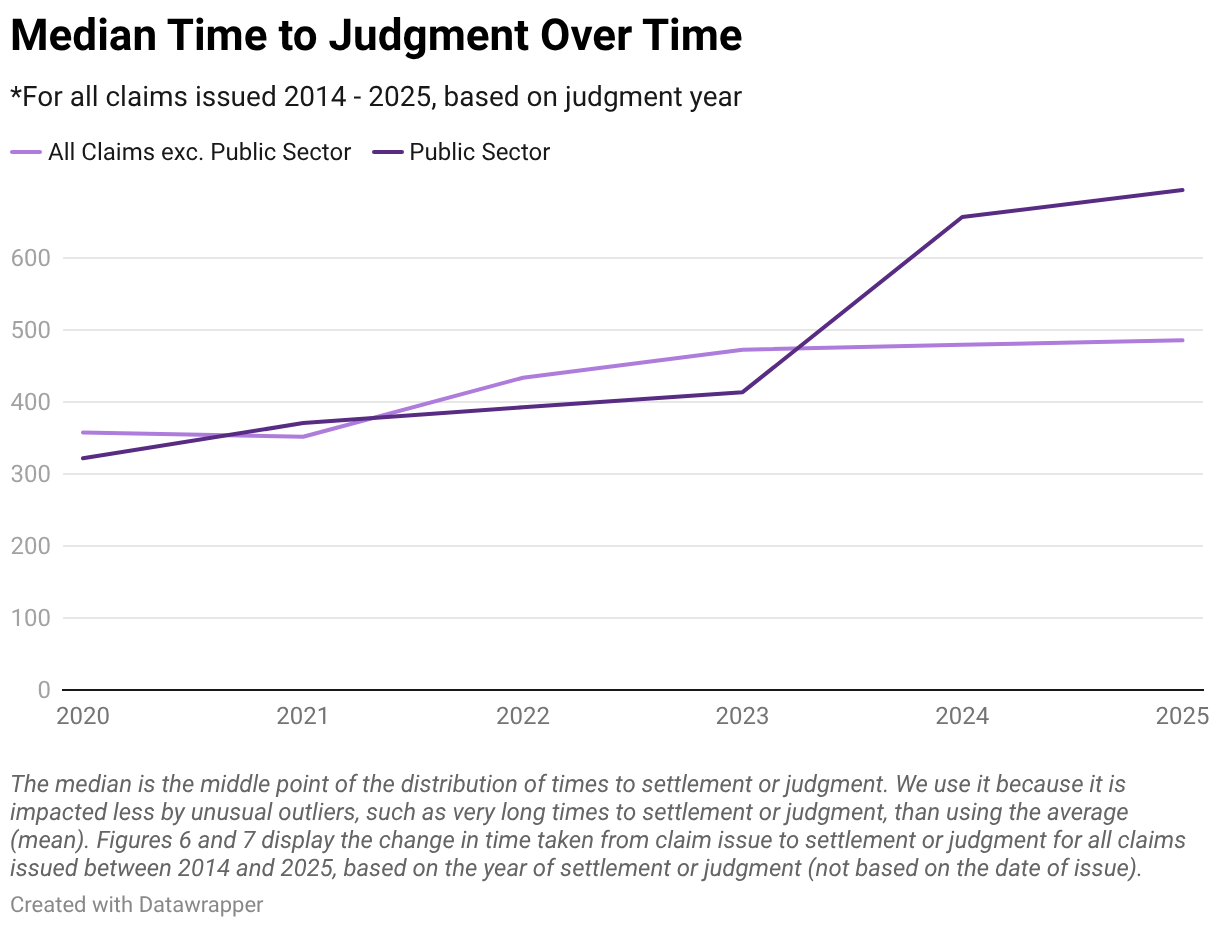
The data shows it can take potentially years to reach settlement or judgment. Further, it is taking longer for the median case to reach settlement than it is for judgment and the gap is widening. There are many reasons why this may be, for example, cases could be becoming more complex legally, stages such as disclosure could be taking longer, and the availability of court time may be a factor.
There are also potentially many reasons why the gap between time to settlement and time to judgment has increased. One is that parties may be building in more time for alternative dispute resolution.
The data also shows that time taken to settlement is not spread evenly across public sector organisations. The range of times taken to settlement differs, both for the middle half of cases (the 25th to 75th percentile) and for the outliers. This may reflect the different nature of the cases involved but also different priorities and governance requirements for each different type of organisation.
Public Sector organisations involved with litigation need to be realistic about how long their dispute may take. This helps, for example, when considering what resources and external support are required and when, and the potential costs involved with the litigation.
Knowing the range and average times taken to settlement or judgment helps inform the potential range of scenarios that may play out in a specific case and for which an organisation could prepare.
Public sector High Court litigation data is from the High Court Chancery and Kings Bench, and the Competition and Appeals Tribunal. Claims analysed are those where the Claim Form has been filed and the defendant has either served an Acknowledgement of Service or Defence (where a Particulars of Claim has been served). Judicial reviews are held in the Administrative Court. The relevant data is available from MOJ here but otherwise is available in the same way that High Court claim data is and so has been analysed separately.
The following has been excluded from the analysis in the report:
Parties analysed were grouped into the following sub-groups:
Data from or regarding the following was not available for analysis in this report:


Trends and insights from ten years of High Court data.
Read the full report
 Legal updates
1 October 2026

/Passle/5d9604688cb6230bac62c2d0/SearchServiceImages/2026-09-17-11-22-53-614-6aabcd8d4a11247c3619743d.jpg)
Thought leadership
16 September 2026
/Passle/5d9604688cb6230bac62c2d0/SearchServiceImages/2026-09-16-13-56-55-330-6aaaa0277131791624e8f6e1.jpg)
Thought leadership
3 September 2026
/Passle/5d9604688cb6230bac62c2d0/SearchServiceImages/2026-09-01-08-17-53-210-6a968a315b49dbc4a9b8d96c.jpg)
Thought leadership
17 August 2026
/Passle/5d9604688cb6230bac62c2d0/SearchServiceImages/2026-08-17-12-49-11-457-6a8303477533d54440c5b4d4.jpg)
Thought leadership
17 August 2026
/Passle/5d9604688cb6230bac62c2d0/SearchServiceImages/2026-08-17-10-55-37-033-6a82e8a98f6deb11a13873e8.jpg)
Thought leadership
31 July 2026
/Passle/5d9604688cb6230bac62c2d0/SearchServiceImages/2026-07-31-15-07-49-657-6a6cba4551520cedf2d68f10.jpg)
/Passle/5d9604688cb6230bac62c2d0/SearchServiceImages/2026-07-30-17-42-42-066-6a6b8d12e94c938b93bf2d40.jpg)
Legal updates
29 July 2026

Want more Burges Salmon content? Add us as a preferred source on Google to your favourites list for content and news you can trust.
Update your preferred sourcesBe sure to follow us on LinkedIn and stay up to date with all the latest from Burges Salmon.
Follow us