

 Guides
Linked Investment Company planning: What you need to know

29 Jul 2026
5 min read
This website will offer limited functionality in this browser. We only support the recent versions of major browsers like Chrome, Firefox, Safari, and Edge.
Guides



This guide explains how Linked Investment Companies (LICs) are used in practice, why they can be an effective tool for business owners, and where they can add real value. We explore how LICs can help separate investment and trading assets, support succession and exit planning, and provide a tax-efficient structure for holding and reinvesting wealth generated by a trading business.
“Linked investment company” is not a legally defined term, so you may see it used to mean different things in different contexts.
For the purposes of this note, we use it to refer to a form of holding company which is inserted between shareholders and a trading company and which can provide a number of practical and tax advantages as compared to direct ownership.
A simple example might look like this:
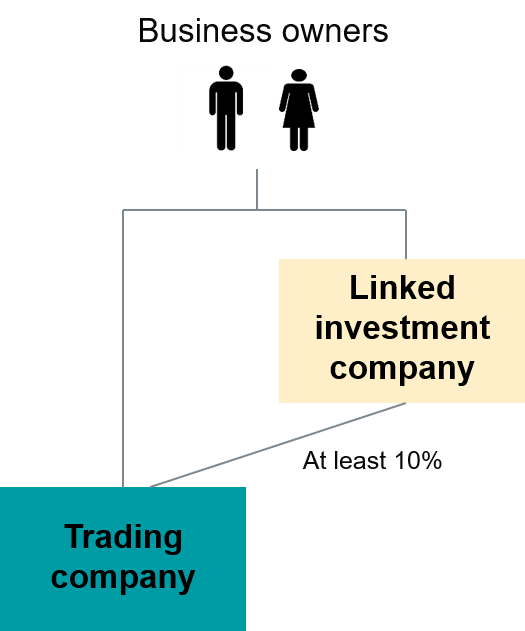
The potential benefits of a LIC include:
A LIC can be used to extract surplus cash or investment assets from a trading company in a tax efficient manner.
Siloing higher-risk investments, new ventures or other non-core business opportunities helps ring-fence an established trading business from commercial risks, allow the exploration of new ventures and (if relevant) prepare a business for sale.
It can also simplify access to valuable UK tax reliefs for the trading business, such as business property relief from inheritance tax.
Provided that the LIC holds at least 10% of the share capital in the trading company (and it will often hold more than 25% for reasons explained below) it may be able to access the “substantial shareholding exemption” such that it will suffer no UK tax when it sells its interests in the trading company.
This can allow the gross proceeds from all or part of an exit to be re-invested, rather than losing a material portion to tax up-front.
Whether holding cash extracted from the trading business or proceeds from an exit, a LIC can provide a tax-efficient environment for investment growth.
For example, within the LIC:
That being said, tax will always need to be considered carefully as there are some downsides to investing within a corporate. For instance, there can be additional tax when value is extracted from the LIC and some tax reliefs available to individuals are not available to companies.
LICs can be tailored to a particular individual’s or family’s situation and needs and this includes succession planning.
Just by way of example, there are various ways in which shares in the LIC can be given to the next generation so as to pass wealth on to them. In particular, “growth shares” can be used to gift future increases in value, or steps can be taken to gift existing value in the trading company using hold-over relief.
In either case, restrictions can be put in place to allow the older generation to control the younger generation’s access to value.
A LIC used for succession planning might look like this:
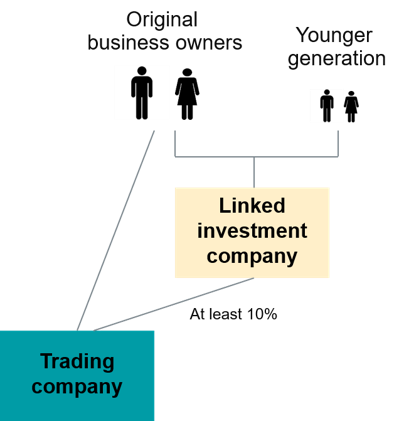
The exact process will vary from case to case but generally involves:
For a number of reasons LIC planning should generally be undertaken at least 14 months ahead of an exit from the trading business (and generally earlier if possible).
Part of this relates to the tax clearance which is generally sought for the share exchange at step 3 above (this ensures the exchange does not trigger any immediate tax for any party). In order for the exchange to be tax neutral the LIC generally needs to be acquiring more than 25% of the trading company.
The LIC also needs to hold its shares in the trading company for at least 12 months in order to be eligible for the substantial shareholding exemption on an exit.
Explore our full private wealth offering and expertise using the link below.
Learn more



 Thought leadership
28 September 2026

Thought leadership
24 September 2026
/Passle/5d9604688cb6230bac62c2d0/SearchServiceImages/2026-09-24-11-37-38-693-6ab50b82d87dc86f2a6a0cbb.jpg)
Legal updates
9 September 2026

Thought leadership
7 September 2026
/Passle/5d9604688cb6230bac62c2d0/SearchServiceImages/2026-09-07-17-20-00-533-6a9ef240ed7d1242d376de3e.jpg)
Thought leadership
19 August 2026
/Passle/5d9604688cb6230bac62c2d0/SearchServiceImages/2026-08-18-17-19-36-630-6a849428cd31376b5941a133.jpg)
Legal updates
4 August 2026

/Passle/5d9604688cb6230bac62c2d0/SearchServiceImages/2026-07-31-17-56-25-048-6a6ce1c93e6f21190c92a10f.jpg)


Want more Burges Salmon content? Add us as a preferred source on Google to your favourites list for content and news you can trust.
Update your preferred sourcesBe sure to follow us on LinkedIn and stay up to date with all the latest from Burges Salmon.
Follow us