

 Thought Leadership
The return of “proper pensions”? Government consults on guided retirement framework

18 Nov 2026
23 min read
This website will offer limited functionality in this browser. We only support the recent versions of major browsers like Chrome, Firefox, Safari, and Edge.
Thought Leadership



On 3 November, the DWP, the Pensions Regulator (TPR) and the Financial Conduct Authority (FCA) launched a joint consultation on proposals for implementing new guided retirement requirements for DC schemes. Badged by the Pensions Minister as the “return of proper pensions”, and described in the consultation as its “core retirement policy”, guided retirement is a central plank of the Government’s ongoing reform programme, which has at its heart a vision for a future with fewer, bigger, more well-run schemes that provide better outcomes for members.
The consultation paper elaborates on some of the principles outlined in the July 2026 policy paper and sets out the proposed shape of the new guided retirement framework. Running to some 71 questions, industry input is sought on some key tenets of the Government’s vision for guided retirement. Whilst many of the questions focus on the ability of master trusts and contract-based providers to deliver default pensions that meet the new requirements, there are also questions addressed to trust-based schemes more broadly.
The consultation closes on 22 December 2026, and comes at what is a busy time for DC pension reforms. This guided retirement consultation is running alongside a consultation on draft regulations to implement Retirement Collective Pension Schemes (RCPS). RCPS is the new name for Retirement CDC – a re-brand announced in the Government’s response to its October 2025 consultation, which was published together with the draft regulations on 3 November 2026. You can read our summary of the RCPS response and draft regulations here. There are also broader policy developments impacting the DC market, including the consultation on draft guidance on fiduciary duties of trustees in relation to investment decision-making and the newly published response from the DWP to its consultation on trusteeship and governance.
The consultation paper is detailed and technical, as therefore is this article. It covers key areas including:
We have also included some initial commentary on the proposals, as well as actions that trustees, scheme managers and employers can and should be taking now. An important message for providers is that whilst on the current timeline guided retirement requirements won’t come into force for the first tranche of schemes until “summer 2029”, there is a significant amount of work for schemes to do between now and then to get “guided retirement ready".
A reminder: PSA26 framework for guided retirement
The Pension Schemes Act 2026 (PSA26) introduces a legal duty for occupational DC schemes to provide “default pension benefit solutions” for DC members.
The relevant provisions are not yet in force, but under s50, trustees or managers of occupational pension schemes providing money purchase benefits (other than those schemes excluded by regulations) will be required to “design and make available to each eligible member of the scheme, one or more default pension benefit solutions”.
A default pension benefit solution can be for the whole membership or a cohort within the membership. It must be designed to provide a regular income for eligible members in their retirement (whether or not alongside other benefits – unless a particular group of members is excluded by regulations) and there is a list of factors for trustees and scheme managers to consider when designing their default(s) including:
“Eligible member” means a member accruing or with an actual or prospective right to money purchase benefits.
s51 permits the scheme to partner with another arrangement to provide their default solution where either:
It is against the backdrop of these framework provisions in the PSA26 that the consultation paper now sets out more detail about the shape of the proposed guided retirement regime. We consider the consultation proposals below.
Which schemes are in scope?
The overarching principle is that guided retirement will apply to occupational pension schemes with members who are “primarily DC savers”. This table summarises the current proposals in relation to which types of arrangement will need to provide guided retirement.
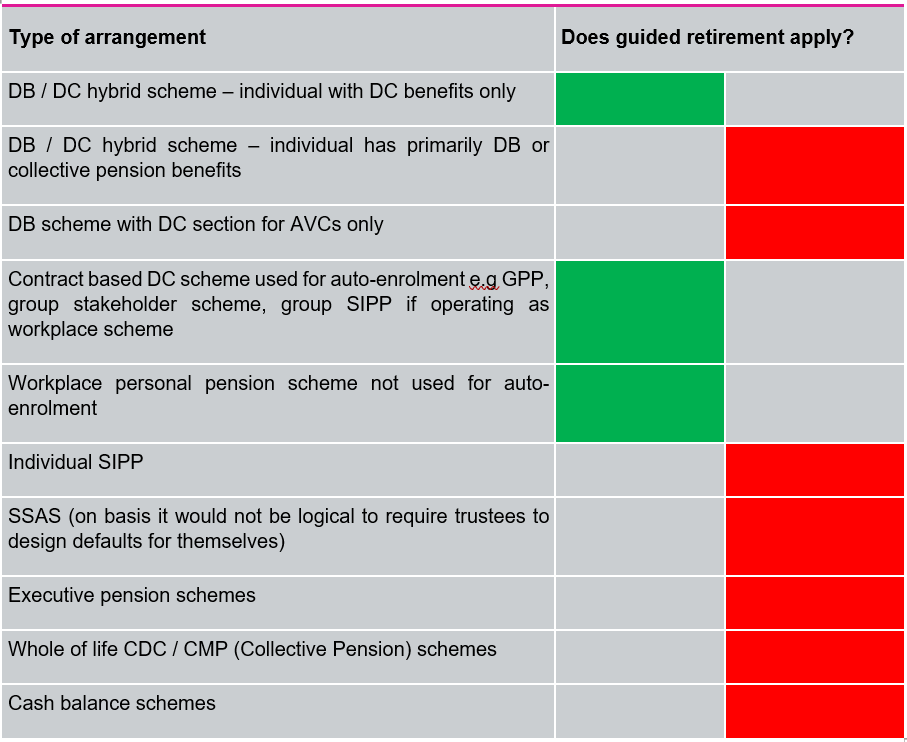
The scope is intended to be broad, with the possibility of extending the reach to individual (i.e. non workplace) SIPPs and other non-workplace pension arrangements in future noted and views invited.
Which members are in scope?
Again, the scope of proposed member eligibility is broad:
Specific exemptions are proposed for members who would otherwise be in scope where the value of the pot is £1000 or less (i.e. is therefore in scope for automatic consolidation via the new small pots regime). It is proposed that this exemption tracks any future changes to the small pots consolidation legislation.
At the other end of the spectrum, for members with high value pots, no specific exemption is proposed but it is recognised that this is not the target cohort for the guided retirement solutions – members with high value pots are more likely to seek individual financial advice and make tailored decumulation choices. Feedback is invited on whether a specific exemption should be included, and if so at what pot size.
What are the default requirements?
As recapped above, some very broad parameters about the requirements for default pension benefit solutions were set out in the PSA26. The consultation builds on this; paragraph 3.3 provides a helpful summary of proposals in terms of the required elements of a default pension, and the factors trustees and scheme managers must consider when designing a default.
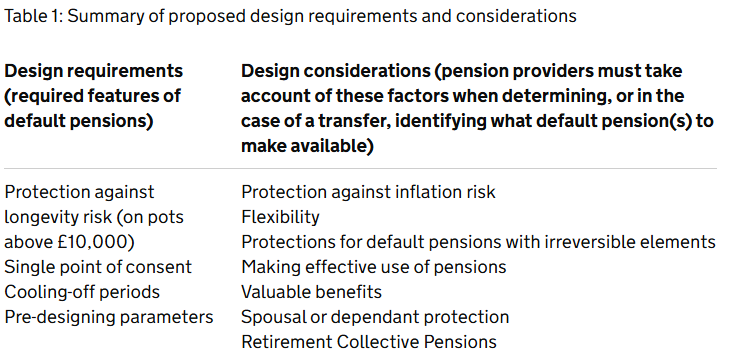
The factors in the right-hand column are the minimum required to be considered in ensuring the default pension meets the needs of the membership (or cohort of the membership) – and trustees and managers will be expected to able to demonstrate they have been considered. However, they are free to consider additional factors too where relevant.
It is notable that RCPS is specifically listed as a standalone required factor schemes must consider. The Government has not gone as far as mandating that schemes must use RCPS as their default pension but the consultation highlights that RCPS is “being developed specifically for use as a default pension”. We know from the RCPS consultation response and draft regulations that, at least initially, RCPS will only be accessible via the guided retirement route – individual members will not be able access these arrangements on the open market. There seems to be a clear preference that, where appropriate for a particular cohort, RCPS should form part of the default pension.
There are some important proposals put forward in respect of the shape of the default pensions, particularly in respect of the requirement to consider longevity and provide a regular income. This includes:
Partnering with another provider to provide a default pension
Under the PSA26 provisions, trust-based schemes can partner with another provider to deliver a default pension for their members where one of the two conditions in s51 is met (either "not reasonably practicable” to provide in scheme or external provider likely means “better outcomes”). The consultation elaborates that:
Equivalent rules will be provided by the FCA for contract-based schemes.
A key requirement to note is that member consent is required for a transfer to another provider (this is required by s51(10) PSA26). Under the consultation proposals consent would be obtained “at the point of access”, meaning the consent to transfer would be given at the same time the member selects their pension (as part of the “single key consent moment” referred to below).
In relation to the mechanics of these transfers, views are sought as to whether a set list of what transfer agreements between schemes and partners must contain should be prescribed in regulations / FCA rules. The PSA26 gives the Government power to make regulations in a number of other key areas; the consultation confirms there is no intention at this stage to use these powers to make regulations in relation to:
As announced in the October 2026 Budget, provisions will be included in the Finance Bill 2027/28 to ensure that members do not lose tax protections as a result of transferring their pension between schemes at retirement. The consultation envisages that protection will be maintained where “a member transfers all their DC pension rights from a pension scheme to another registered pension scheme to enable benefit payment and within three months of the transfer the member crystallises all their pension rights under that scheme”.
Member journey
A helpful illustrative example of a simplified member journey is included in the consultation.
Under the proposed framework members will be given the option of “self-selecting” into an alternative default pension (where the scheme offers different solutions to different cohorts) or another option made available by the provider. Providers will need to make sure the range of defaults the member is told about are “appropriate” for that individual – the example given is not offering a default designed for members in ill-health to the broader membership.
The interaction with the targeted support regime is highlighted, with the aim being to provide a “seamless” service. Both targeted support and guided retirement target a similar membership demographic – those who might not pay for individual financial advice to design a bespoke retirement solution for their needs. The consultation proposes that, where it is available, “targeted support should form part of an integrated service, so individuals have a coherent experience. Under the proposed guided retirement framework, pension providers will be required to understand the needs and interests of their members, identify cohorts, allocate individuals to appropriate default pensions and provide support based on limited information, activities which will operate in the same way as targeted support”.
In another flag of further reforms to come, the consultation notes that it “expects” further changes in the future to enable targeted support (or services akin to targeted support) to operate within trust-based schemes, and support individuals who wish to consider alternative retirement options.
Member communications
There is a whole chapter of the consultation dedicated to member communications, recognising the pivotal and challenging role member engagement and understanding will have in the success of guided retirement.
Communications objectives for the guided retirement framework are set out in the consultation, and the proposal is that these largely are implemented via existing governance frameworks across the trust and contract-based markets. In terms of specific communications, additional requirements will be implemented through regulations and rules only where necessary to ensure there is a clear framework for the minimum level of information and support members must receive. For example, the proposals suggest there will be a requirement for schemes to adapt existing “wake up” communications for default pensions.
Again, there is a helpful example flow chart of what a member’s default pension communication journey will look like across their lifetime in the scheme.
For trust-based schemes, there will be a new requirement to provide “retirement-focused communications from five years before an individual reaches their Normal Minimum Pension Age (NMPA), with further communications at 5 year intervals thereafter until benefits are accessed”. The consultation confirms that this would be in addition to existing requirements to provide wake-up communications at four months before pension access.
The proposal envisages using NMPA based-triggers for trust-based scheme communications, to allow it to track future changes to access ages. However, it is noted that there is a divergence from the regime for contract-based schemes and Pension Wise guidance, which both use age 50 as a trigger – views are invited on whether NMPA or age 50 is preferred. Interestingly there is a proposal to require pension providers to include “factual and neutral” consolidation messaging within wake-up communications. The proposal is for such communications to include the following information:
In relation to the impact of drawing a PCLS, the consultation identifies a concern that members may not always understand the impact of taking a PCLS on their future retirement income. It proposes a new requirement for pension providers to explain the potential impact of taking a PCLS, to make clear that money taken as a lump sum means a reduction in the income available in retirement. The suggestion is that illustrations or examples are included.
For the “at the point of access” communication (other than where taking only a PCLS with the rest of the member’s benefits remaining invested), members should be presented with the default pension they have been allocated to (following a period for gathering of any additional information needed to allocate the individual to their cohort and associated default). This will be the option that applies to them unless they select an alternative decumulation option. They will have the opportunity to access financial advice or targeted support where relevant.
In terms of the level of information schemes are required to provide to the member about the default, the consultation envisages a balancing act – giving members sufficient information to understand the default they have been allocated to, whilst not overwhelming them. A suggested list of aspects of the default that the provider should explain to the member is set out at paragraph 5.43. This is described as the “core information” that must be disclosed at the point of access – the consultation envisages that how the information is presented will be a matter for the individual scheme, with freedom to provide additional information where the provider considers it would support member understanding.
The interaction with existing communication requirements, in particular the “Stronger Nudge to Pension Wise Guidance” is considered. In particular, views are sought about whether requiring individuals to complete the existing Stronger Nudge process (which requires them either to take up a Pension Wise appointment or opt out) adds too much “friction” to what is intended to be a simpler journey into a default pension.
The consultation also addresses what communications should look like during retirement. For example, it is proposed that, where a member seeks to draw down more than the default pension product envisages, this would trigger a requirement for the provider to warn the member that the proposed drawdown takes them outside the default product parameters (and if they proceed the provider would be expected to reallocate them to another product – with their consent).
Governance
The aim is to develop consistent governance outcomes across the trust and contract-based markets, whilst recognising that the frameworks for achieving these will look different for each.
Trust based schemes
Contract-based schemes
On a related note, there is a chapter of the consultation dedicated to compliance and enforcement. This article does not examine the proposals in detail but notes the Government intends to use its regulation-making powers to legislate to allow TPR to issue compliance notices, third party compliance notices and penalties (up to £10,000 for an individual and £100,000 in any other case).
When?
A proposed timetable for implementation of guided retirement requirements is included in the consultation. The dates included are based on the Government’s current estimates and are subject to change but give schemes and providers helpful targets to work towards.
It is envisaged that implementation will be phased, starting with master trusts and FCA-regulated schemes in “summer” 2029, with obligations for “common employer group master trusts” and single employer trusts to follow in summer 2030. The rationale is that the latter cohort are more likely to seek to offer a default pension through transferring members to another qualifying scheme and therefore it makes sense to give opportunity for the market of defaults offered by large master trusts to get up and running.
For master trusts offering RCPS as their default, there is a concession – it is proposed they will be required to comply with PBS requirements by summer 2029, but default pension requirements will not kick in until summer 2030.
For schemes that may be in the process of consolidating / winding up when the guided retirement requirements come into force, the requirements will still apply. It is proposed that those schemes use the option to partner with an external provider (presumably using the “not reasonably practicable” condition in s51) and transfer members to them in order to provide a default pension.
Commentary
What about benefits in other arrangements – to what extent are schemes required to design a solution that considers the individual’s other retirement savings / wider financial circumstances? This is recognised in the consultation but a substantive solution is not proposed at this point in time – there is a reference to an expectation for pension providers to “consider aspects such as individuals’ other sources of pension wealth” but no clear suggestions about how to gather that information, or evaluate it.
This will be a key practical challenge when designing and allocating individuals to cohorts. If a member has a much larger DC pot elsewhere, a default that suggests e.g. an annuity with spouse’s pension and inflation protection from a much smaller pot is unlikely to be a desired solution.
Further consolidation of pots in the pipeline? There is an interesting reference in paragraph 3.7 to the possibility of future legislation to support greater consolidation “to help savers make the most of the totality of their savings in retirement”. The consultation says that it will explore mechanisms, including “what trustees are able to do within current rules to help people consolidate pots in respect of which a default pension can then be arranged” and will engage with stakeholders on these matters “in due course”. This appears to be connected with the challenge identified above of designing appropriate defaults and allocating individuals to suitable cohorts where their pension savings are spread across multiple schemes.
Later in the consultation, paragraph 5.27 – 5.31 considers communicating with members about consolidating their pensions and what that messaging should look like. And the consultation also notes that the Government may look to extend the value for money framework to the decumulation phase in the future – another lever by which further consolidation in the market at a scheme level may be achieved.
Greater protection for trustees and scheme managers? There doesn’t seem to be any suggestion that there will be any additional standalone protection for trustees and managers from e.g. complaints from members who go along with the default pension chosen for them but are later dissatisfied with their arrangements (it is noted that it is the intention that the Pensions Ombudsman (trust based schemes) and Financial Ombudsman Service (contract-based schemes) will have jurisdiction over member guided retirement complaints). Responsibility and oversight of third parties (and their products) is addressed in paragraphs 6.41 – 6.47 but the proposal is that this is all dealt with within the existing TPR / FCA governance frameworks.
In one sense this is understandable, most members are already in defaults during the accumulation period of their pension, and guided retirement just offers a default for decumulation (which members do not have to accept, and indeed must actively consent to). However, as the mainstream media response to the consultation launch suggests, feelings run materially higher in relation to decumulation decisions – see for example the Times’ “Stop the Pension Power Grab” campaign. This is the point at which pensions become “real” and, in many cases, the first time individuals truly engage with their pension choices. Is there an argument to say trustees and managers need some form of standalone statutory discharge, for example, where the proper processes have been complied with and a member has been reasonably allocated to a default that meets all the prescribed design requirements?
Actions for trustees and scheme managers
It is clear that there is a wealth of information schemes will need in order to design their default pensions for their membership. Many smaller and own trust arrangements are likely to be looking to partner with other providers to provide the retirement product(s) for their membership.
Although the proposals are still at the consultation phase, the broad shape of the proposed guided retirement regime is now much clearer and there are plenty of actions for trustees and scheme managers to be taking forward now, including:
Actions for employers
Our team of DC specialists are very well-placed to assist you with understanding all aspects of the new guided retirement duties, and planning for implementation. If you would like to discuss any aspect of this article please do get in touch with Susannah Young, Helen Woodford or your usual Burges Salmon pensions team contact.
This article was written by Louise Pettit and Helen Woodford
 Thought leadership
17 November 2026

Podcasts
17 November 2026 • 6 min read





Podcasts
3 November 2026 • 6 min read


Thought leadership
27 October 2026

Want more Burges Salmon content? Add us as a preferred source on Google to your favourites list for content and news you can trust.
Update your preferred sourcesBe sure to follow us on LinkedIn and stay up to date with all the latest from Burges Salmon.
Follow us