

 Thought leadership
Driving Decarbonisation: The role of rail freight and multi-modal logistics

24 Feb 2026
4 min read
This website will offer limited functionality in this browser. We only support the recent versions of major browsers like Chrome, Firefox, Safari, and Edge.
Thought leadership
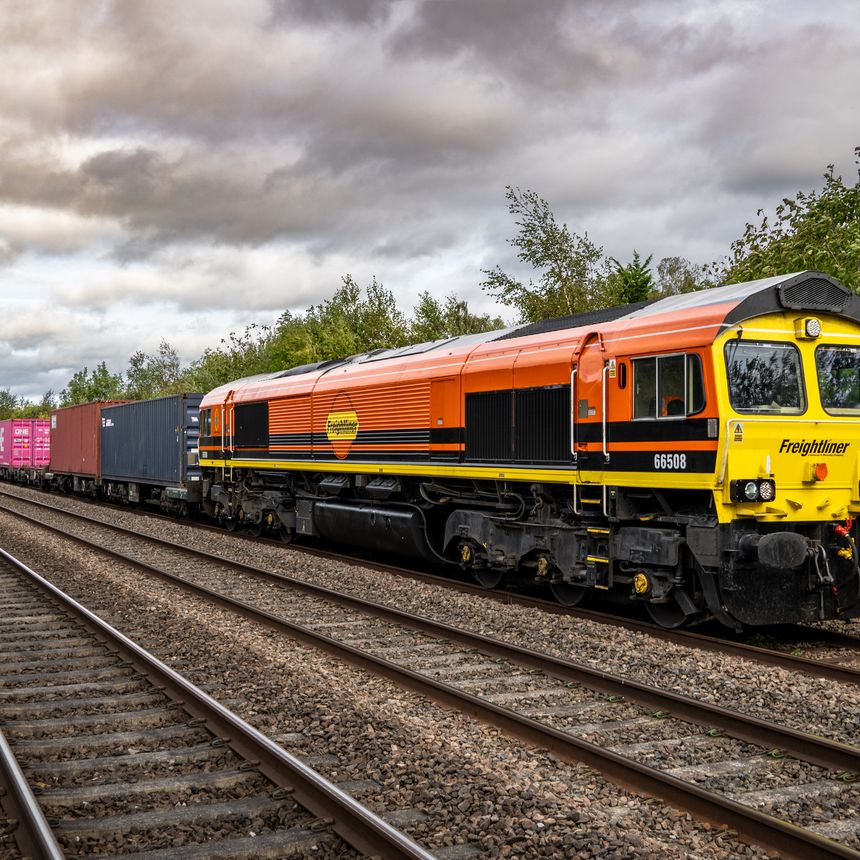


Rail freight already plays a critical role in reducing emissions from logistics, alleviating congestion on the road network and improving air quality, whilst moving a range of commodities from supermarket goods to construction materials for nationally significant infrastructure projects.
Looking ahead, rail freight has the potential to do even more. Investment in electric and alternative‑fuel traction, alongside the evolution of rail freight terminals into multi‑modal hubs, is opening up new opportunities to further decarbonise logistics while supporting the growth of electric and zero‑emission road transport. In this way, rail freight is not a substitute for other low‑carbon solutions, but a key component of an integrated, sustainable logistics system.
Against a backdrop of evolving government policy and increasing focus on supply‑chain emissions, this article explores the opportunities for rail freight growth, the role of multi‑modal logistics in achieving Net Zero ambitions, and the legal, commercial and infrastructure challenges that businesses will need to navigate.
The Climate Change Act 2008 requires the UK to achieve net zero by 2050. The transport sector is currently the highest emitting sector and in 2023 domestic transport accounted for 29% of total domestic emissions in the UK. [1]
The government acknowledges that supporting modal shift to rail freight is essential to enabling it to meet its environmental targets, citing that a diesel-hauled freight service reduces carbon emissions by up to 76% per tonne compared to road haulage. [2]
The Railways Bill published in November 2025 provides that the Secretary of State must set and publish a target to increase the use of rail freight and that Great British Railways must have regard to that target when exercising its statutory functions. The government has confirmed that there will be an overall target of a 75% increase in rail freight by 2050 alongside other targets which will be announced before Great British Railways commences operations. [3]
This growth may come from companies increasingly using rail as part of a wider sustainable, multi-modal logistics solution – using rail as the carrier of choice between ports and strategic rail interchanges with electric vehicles effecting the final mile.
This means that rail freight terminals can become “hubs” where different forms of transport meet, and where journeys start and end. Rail terminals are therefore ideally placed to provide services such as vehicle charging (covering everything from HGVs to bikes), battery swapping and refuelling (particularly for hydrogen and biofuel powered vehicles, for which there are very few publicly available options).
Rail freight locomotives with alternative forms of traction are now being procured. For example, the Stadler Class 99 bi-mode train is being introduced by GB Railfreight, combining electric power and HVO fuels and DB Cargo recently trialled a Stadler Class 93 tri-mode train owned by Rail Operations Group.
Technology is developing to allow for charging batteries whilst a train is stabled, but rail terminals also need to be developed to support this technology. Freight operators who develop depots that can rapidly charge the large batteries required for locomotives and HGVs will have an advantage in providing customers sustainable transport options that are reliable and well-resourced.
The move towards multi-modal transport brings a need for new energy infrastructure – rail freight depots will be ideally placed to capitalise on this need, and investment in that infrastructure could both solve their own energy challenges and create future revenue streams as service providers to other transporters.
To capitalise on the opportunity, those looking to provide multi-modal logistics solutions may have to grapple with some (or all) of the following challenges:
Time is often of the essence in freight transport – whether due to transporting perishable goods or simply working to meet challenging delivery windows, freight transporters are likely to be on strict timelines and will need to know that they can rely on charging or refuelling options being available and operational. Freight transporters will need to invest in both high quality technology and ongoing maintenance of charging stations and other energy infrastructure at their depots to ensure that these can provide the consistent and reliable service exactly when it is needed.
While the investment required to achieve this may be off-putting to some, there are opportunities to bring in significant new revenue streams by opening up depots and charging facilities to various third party fleets whose routes might pass nearby. We have previously advised First Bus on the legal and contractual issues involved in opening its electric bus charging facilities to other EV fleets.
Whilst EVs have conclusively won the race when it comes to zero emission passenger vehicles, freight transport has additional challenges due to the size and weight of vehicles and duty cycles. Previous government funded demonstrations have trialled a range of battery electric, hydrogen fuel cell and hybrid solutions, with others looking at “battery swap stations” as a solution to the challenges of charging at pace.
Whilst investment it crucial, it can be difficult to know which technology to back. Following The UK’s Modern Industrial Strategy 2025, the government is planning to publish a new freight and logistics plan. Operators should keep a close eye on this to identify support and opportunities they can capitalise on to develop rail freight hubs fit for the future.
Most of these new technologies are an unknown entity for insurers or are currently viewed as high risk. Bringing third parties on-site to use charging and refuelling infrastructure also brings in a new risk. Terminals on leased land may also require freeholder consent to install new infrastructure. It is crucial to bring on board insurance and legal advisers at an early stage to assess feasibility at a project level, not just the feasibility of technical solutions.
While freight trains powered by overhead lines will have access to a steady electricity supply, electric HGVs will have a huge demand for power to charge at transport hubs. Obtaining grid connection capacity is one of the major blockers to large-scale charging facilities, and although grid connection reform is currently ongoing, this challenge is not expected to disappear in the near future.
Freight operators could be well placed to make use of a private wire and on-site energy generation, with terminals offering the space to install solar panels and small wind turbines either within the site itself or nearby. This reduces reliance on grid connections and guarantees access to green power. New players in the market are offering innovative integrated generation and charging solutions (with opportunities to sell excess electricity to nearby buildings), such as the SolarCatcher solution that we previously advised on.
Net Zero continues to be a key focus for the government, with funding programmes such as the Freight Innovation Fund Accelerator and the Zero emission heavy goods vehicles and infrastructure competition showing that there is a need for, and an appetite to fund, innovation which will accelerate the freight sector’s progress towards decarbonisation.
Achieving Net Zero targets requires a multi-modal approach and collaboration between different transport operators. In addition to delivering decarbonisation aims, the increasing interfaces between different modes of transport will present a great commercial opportunity for rail freight operators in particular as freight depots increasingly become the points of intersection.
At Burges Salmon, we are well equipped to support the shift towards sustainable transport and multi-modal solutions. With our market leading and cross sector expertise, we work with our clients to support them in achieving their Net Zero goals.
For further information or advice related to any of the topics discussed, please contact Lydia Cullimore, Chris Lewis, Charlotte Robinson or your usual Burges Salmon contact, and sign up to our rail freight mailing list to receive our latest updates.


 Thought leadership
2 April 2026
/Passle/5d9604688cb6230bac62c2d0/SearchServiceImages/2026-04-02-10-51-04-358-69ce4a18af477596a81a715e.jpg)
Thought leadership
1 April 2026
/Passle/5d9604688cb6230bac62c2d0/SearchServiceImages/2026-04-01-08-43-26-813-69ccdaae3503d602de8de46e.jpg)
Thought leadership
1 April 2026
/Passle/5d9604688cb6230bac62c2d0/SearchServiceImages/2026-04-01-08-38-26-748-69ccd9823503d602de8dd563.jpg)
Podcasts
31 March 2026 • 5 min read

Thought leadership
31 March 2026
/Passle/5d9604688cb6230bac62c2d0/SearchServiceImages/2026-03-31-13-01-10-478-69cbc596a6017948afee8b1b.jpg)
/Passle/5d9604688cb6230bac62c2d0/SearchServiceImages/2026-03-31-08-15-31-647-69cb82a3781b3d9206ac7892.jpg)
/Passle/5d9604688cb6230bac62c2d0/SearchServiceImages/2026-03-25-12-45-26-744-69c3d8e6c04c876c1a12aef9.jpg)
Thought leadership
20 March 2026
/Passle/5d9604688cb6230bac62c2d0/SearchServiceImages/2026-03-19-21-05-36-520-69bc65204151689c7a76e630.jpg)
Thought leadership
18 March 2026
/Passle/5d9604688cb6230bac62c2d0/SearchServiceImages/2026-03-18-10-39-31-679-69ba80e3305a622f22f1257d.jpg)
/Passle/5d9604688cb6230bac62c2d0/SearchServiceImages/2026-03-18-15-35-46-811-69bac65218700311004575c8.jpg)
Want more Burges Salmon content? Add us as a preferred source on Google to your favourites list for content and news you can trust.
Update your preferred sourcesBe sure to follow us on LinkedIn and stay up to date with all the latest from Burges Salmon.
Follow us