

 Legal updates
Trusts in the context of UK/US planning

9 Nov 2026
4 min read
This website will offer limited functionality in this browser. We only support the recent versions of major browsers like Chrome, Firefox, Safari, and Edge.
Legal updates



Trusts are familiar concepts in both the US and UK and, when used appropriately, they can offer very material tax and estate planning benefits.
However, they also require careful planning because their tax treatment in the two jurisdictions can differ markedly.
For US citizens who are tax resident in the UK, the core problem is often that the US and UK may tax different people, at different times, in relation to the same structure. This mismatch can result in double taxation which the treaty between the US and UK struggles to relieve.
US persons considering a move to the UK (or already here) should make sure that they are comfortable with the treatment of their trusts in both countries and take advice accordingly.
The image below provides a simple example of how differing UK and US tax treatment can result in double taxation:
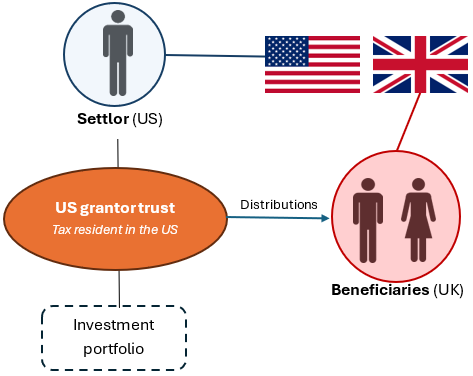
The US may look to tax the investment returns on the settlor, whereas the UK may look to tax the beneficiaries when they benefit from the trust.
Both the UK and the US charge inheritance tax (known as estate tax in the US) at a rate of up to 40%.
However, the tax-free thresholds in the two countries differ markedly. In the absence of other reliefs, the US allows transfers of up to $15 million (at least at a federal level) before estate tax starts to apply. In the UK this might be as low as £325,000.
As a starting point, anyone who has been UK tax resident for at least 10 tax years could be exposed to UK inheritance tax on their worldwide assets (whether held personally or in trusts). More detail on the criteria can be found here: The UK’s new tax regime for internationally connected individuals and their structures.
However, US citizens can make use of the very generous terms in the US/UK estate tax treaty to reduce the impact of this, including by establishing trusts which provide indefinite protection from UK inheritance tax.
This makes trusts a very valuable tool for US citizens moving to the UK.
The planning is often safest either before the move or within the first three years of residence in the UK so considering it early is key.
The income tax and capital gains tax position often requires considerable care, not least because many trusts which are “transparent” in the US are effectively opaque for UK tax purposes.
Where the UK and the US treat a trust differently, there is a real risk of double taxation. This table summarises the treatment of three key US trust types in the US and the UK:
|
US trust type |
US tax position |
UK tax position |
Main double tax risk |
|---|---|---|---|
|
Grantor trust |
Grantor is generally taxed on trust income and gains as they arise. |
Beneficiary is generally taxed when they receive a distribution or benefit. |
Different taxpayers and potentially different tax years. |
|
Non-grantor domestic trust |
Trustees are taxed unless “distributable net income” is distributed and taxed on a beneficiary. |
Beneficiary is generally taxed on receipt of payments or benefits. |
Timing mismatch if distributions are delayed. |
|
Foreign non-grantor trust for US purposes |
US throwback rules may apply where income is accumulated and later distributed to a US beneficiary. |
UK matching rules may tax distributions by reference to accumulated income or gains. |
Potentially material tax exposure in both jurisdictions, with complications when applying treaty relief. |
Whilst these disparities need to be looked at carefully in each case, the double taxation risk can often be reduced or mitigated entirely with appropriate planning.
Trusts can then be used to achieve a number of goals, whether for their inheritance tax benefits as mentioned above, or for other purposes such as asset protection and estate planning.
What is suitable will depend on the circumstances but some key options are set out below:
|
Planning route |
When/why it may help |
Key caution |
|---|---|---|
|
Align settlor/grantor taxation |
It may be possible to argue that a US grantor trust is a “bare trust” in the UK such that it is look-through in both jurisdictions and tax credits are more readily available. |
The UK analysis is often not straightforward and there may be a risk of the UK tax authorities taking a different view. |
|
Use treaty exchange of notes |
Where the US taxes the grantor but the UK taxes the beneficiary, the UK/US treaty can still provide relief from double taxation in certain circumstances. |
Care has to be taken with timing, as there are strict deadlines for claiming tax credits in the US. |
|
Make use of loans to beneficiaries |
Whilst these don’t negate the issues, they can reduce the tax due as compared to outright distributions, thereby mitigating some of the problem. |
Loans tend to give rise to annual tax liabilities, as opposed to one-off charges, and so long-term planning is required. They can also have inheritance tax implications. |
|
Making regular income payments to beneficiaries |
By ensuring that income is paid out regularly, it may be possible to align taxation in both jurisdictions, thereby simplifying the use of tax credits. |
This can reduce flexibility and can have wider UK tax consequences. |
|
Changing the residence of the trust |
If the trustees are subject to tax in the US, making the trust UK resident so that they are also taxable in the UK can be another way of aligning tax in the two jurisdictions and benefiting from treaty relief. |
Trustee residence changes can have numerous tax and administrative consequences. |
When used effectively, trusts can be a very valuable tool in the estate planning toolkit for those with both US and UK connections. However, in the wrong hands they can create a myriad of issues.
The key is to take sensible advice and to be clear on the goals of any planning being implemented.



 Thought leadership
3 November 2026

Thought leadership
29 October 2026



Thought leadership
22 October 2026

Podcasts
15 October 2026 • 10 min read


Want more Burges Salmon content? Add us as a preferred source on Google to your favourites list for content and news you can trust.
Update your preferred sourcesBe sure to follow us on LinkedIn and stay up to date with all the latest from Burges Salmon.
Follow us