

 Thought Leadership
Further Update on Inheritance Tax Reforms: what do those running pension schemes need to know

7 Sep 2026
9 min read
This website will offer limited functionality in this browser. We only support the recent versions of major browsers like Chrome, Firefox, Safari, and Edge.
Thought Leadership
/Passle/5d9604688cb6230bac62c2d0/SearchServiceImages/2026-09-07-17-20-00-533-6a9ef240ed7d1242d376de3e.jpg)


More detail is now available about the information-sharing requirements – this article explains what you need to know.
From 6 April 2027, most unused pension funds and pension death benefits will be brought within the scope of inheritance tax (“IHT”) by being included in the value of a deceased member’s estate for IHT purposes. This represents a significant departure from the long-standing position under which pension benefits were generally excluded from the IHT regime.
Although recent discussions have mainly focused on tax and estate planning, the changes also have important procedural and practical implications for those running pension schemes. This includes trustees of occupational pension schemes, pension providers, public sector scheme managers, and third-party administrators acting on their behalf (collectively, “PSAs”). PSAs will need to understand and support more complex death benefit processes and information-sharing requirements with personal representatives (“PRs”).
It is important for trustees to be actively engaged and prepared for these changes in exercise of their wider fiduciary duties to act in members' best interests, exercise powers under the scheme properly and ensure that communications are clear and accurate. Even where administration has been outsourced to a third-party provider, the trustees still hold ultimate responsibility for ensuring compliance with the scheme’s rules and legislation.
This article forms part of our firm’s series on the implications of the changes to IHT on pensions following on from:
Quick recap: what is changing from 6 April 2027?
For deaths occurring on or after 6 April 2027, most unused pension funds and lump sum death benefits will now be brought within the scope of IHT.
The changes introduced by the Finance Act 2026 (the “Act”) are intended to ensure that pension arrangements are used to fund retirement, rather than being used as a tax planning vehicle to pass on wealth.
The Act also aligns the IHT treatment of different types of pension arrangements. However, PSAs should be careful not to assume that all pension death benefits are now subject to IHT. Broadly, pension death benefits can be categorised as follows:
| In scope of IHT changes | Out of scope of IHT changes | |
| Unused DC pension funds | Spouse’s, children’s and dependant’s pensions | |
| Certain lump sum death benefits, like a return of contributions on the death of a deferred member or a lump sum guarantee payment | Payments to exempt recipients (including certain spouses and civil partners, charities/registered clubs, housing associations and political parties) | |
| Remaining drawdown funds at death | ||
| Death-in-service benefits arising from current employment | ||
| Trivial commutation lump sum death benefits | ||
| Joint life annuities |
What are the new information-sharing requirements?
One of the major operational changes introduced by the Act is the introduction of information-sharing requirements between PSAs and deceased members’ PRs and beneficiaries.
The Registered Pension Schemes (Provision of Information) (Miscellaneous Amendments) Regulations 2026 (the “Regulations”) set out, amongst other provisions, what information needs to be provided by the PSA about the deceased member and to whom, and the applicable timescales for providing that information.
Whilst some basic information will always be required by the PR, where an IHT account is required, PRs will need to obtain further information from PSAs to enable the account to be completed, even where no IHT is ultimately payable. The information must include details of the beneficiaries and the proportion of the deceased’s notional pension property attributable to each beneficiary, as beneficiaries are jointly liable with the PRs for any IHT attributable to those benefits. PSAs must also disclose details of any excluded benefits, such as dependants’ scheme pensions, certain dependants’ or nominees’ annuities, and death-in-service lump sums, to enable the PR to demonstrate why those benefits have been excluded from the IHT calculation.
The Regulations also set out more information about withholding notices, which, by way of reminder, enable a PR to require a PSA to withhold up to 50% of a member’s entitlement under the scheme on account of a potential IHT liability. It should be noted that the 50% withholding power applies only to certain benefits, and that a withholding notice may only be issued where the PR has reason to believe IHT may be due. PRs have 15 months after the end of the month in which the member has died to issue a withholding notice but PSAs do not need to delay paying benefits until the end of that period. A withholding notice can only apply to unpaid assets.
Importantly, where a dependant or other beneficiary seeks information regarding the deceased member's pension benefits, PSAs will need to consider both existing disclosure obligations and the additional requirements arising under the Regulations.
PSAs will not ordinarily be liable for IHT on notional pension property. However, PSAs will become jointly and severally liable with the beneficiary and PR if they fail to comply with a valid withholding notice or payment notice (where a beneficiary or the PR requests the PSA to pay the IHT to HMRC directly out of pension funds). This distinction is important for PSAs to understand.
The process will operate broadly as follows from a pension scheme perspective:
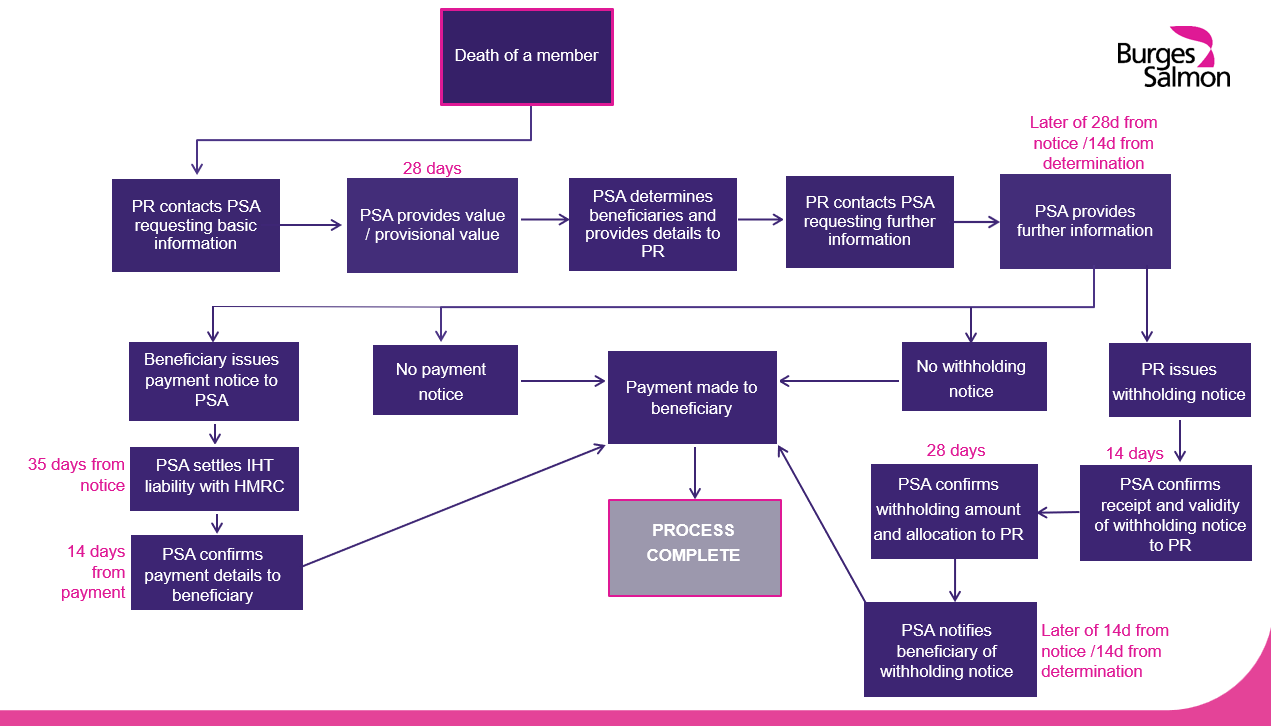
Most of the processes are independent of each other and can be run in parallel. It may therefore be that the PR requests the basic and the further information at the same time and a payment notice could be issued with or without a withholding notice in place.
From a practical perspective, PSAs should expect a substantial increase in requests for information from beneficiaries, PRs and other professional advisers and should be prepared for this and have the systems in place to meet the statutory timescales.
What additional matters should PSAs be considering?
If dependant’s pensions (for spouses, civil partners, children and other dependants) are a feature of your scheme, note that they will only be exempt as a category if there is no other option to pay an in-scope benefit such as a defined benefit death benefit lump sum. Some scheme rules include this option for some or all cases, so schemes may want to review this.
Those running pension schemes should consider how the new procedural and administrative requirements fit within their broader fiduciary and/or statutory responsibilities and duties.
Trustees are required to (amongst other duties) act in the best interests of the scheme beneficiaries, act in accordance with the scheme’s trust deed and rules and legislative requirements, and act prudently, responsibly and honestly. Those obligations do not change because of the IHT changes, however they should be considered in that context to ensure they are complying with their fiduciary duties.
PSAs should also consider the governance implications of the new regime. The increased administrative burden, information-sharing requirements and potential liability risks mean that strong processes and decision-making frameworks will become even more important.
Notional pension property is not treated as having vested in a beneficiary (and the assets cannot therefore be assessed for IHT purposes) until the trustees or other decision-maker have made their decision or identified the recipient of a benefit in accordance with the scheme’s rules. PSAs will need to ensure that decisions around entitlement to benefits are made promptly so the appropriate information can be given to PRs and any necessary payments are made within the requisite timescales.
IHT on notional pension property is due at the end of the sixth month after the date of death, after which late payment interest accrues. This inherent tension with the typical period of up to two years to determine and pay discretionary benefits under pension schemes may affect the urgency of information-sharing between PSAs and PRs.
PSAs will also need to build in the updated reporting requirements about lump sums to PRs to enable them to report on the lump sum and death benefit allowance if the threshold is exceeded.
In addition to their duties, PSAs should also consider how these changes impact the beneficiary experience.
These changes might result in beneficiaries needing to wait longer for benefits to be paid while valuations are obtained and IHT liabilities settled.
PSAs should therefore be understanding about how the administration process impacts a deceased member’s family and beneficiaries through providing accessible explanations and setting realistic expectations around timescales, which may help reduce complaints and improve outcomes for beneficiaries.
The Pensions Direct Payment Scheme is a mechanism allowing beneficiaries and PRs to require the PSA to pay IHT due on pension death benefits directly to HMRC. This is distinct from the withholding process described above.
Where a beneficiary or PR issues a payment notice, PSAs must pay the IHT to HMRC within 35 days of receiving the notice. This creates new operational and payment infrastructure requirements for PSAs. Consideration will also need to be given to the liquidation of illiquid assets to be able to pay any benefits and tax due.
PRs may obtain a clearance certificate from HMRC once they are satisfied the IHT liability has been settled. Importantly, PRs are discharged from liability for pensions discovered after they have received clearance, provided HMRC is satisfied that the PR made every effort to locate the deceased’s pensions. Therefore, PSAs should be relieved from providing further information if there are later-discovered pension arrangements of which the parties were unaware.
The calculation of notional pension property differs between money purchase and defined benefit arrangements. The calculation of benefits for defined benefit schemes is more complex and further detailed HMRC guidance on how PSAs should value notional pension property in complex defined benefit arrangements is still awaited.
Next steps: what should PSAs be doing to help members now?
With the new regime coming into force in under nine months, PSAs should be taking preparatory action now. There are a number of practical steps that PSAs should already be considering.
These include:
PSAs who begin planning now by reviewing communications, administration processes and governance arrangements will be better placed to support members and beneficiaries when the new regime takes effect.
A number of significant pieces of guidance and legislation are still anticipated ahead of April 2027 so PSAs should continue to monitor the position. Whilst this note does factor in points made by HMRC in its second technical note that was published on 27 August 2026, there will be further articles coming with more detail for the various parties affected by the changes.
Burges Salmon has a combination of pensions, employment, trusts and incentives expertise. This article has been written by Alice Honeywill (Partner), Kelly Beattie (Director) and Megan Bruce (Solicitor) in the Pensions and Lifetime Savings team. If you would like to discuss any of the points covered further, please contact either Kelly or your usual contact at Burges Salmon.
 Thought leadership
7 September 2026
/Passle/5d9604688cb6230bac62c2d0/SearchServiceImages/2026-09-07-17-20-00-533-6a9ef240ed7d1242d376de3e.jpg)
Thought leadership
3 September 2026
/Passle/5d9604688cb6230bac62c2d0/SearchServiceImages/2026-08-27-07-55-59-900-6a8fed8f9f47d1c63b4ea2f3.jpg)
Thought leadership
2 September 2026
/Passle/5d9604688cb6230bac62c2d0/SearchServiceImages/2026-09-02-11-09-08-138-6a9803d48c3102bcdcd4cdd3.jpg)
/Passle/5d9604688cb6230bac62c2d0/MediaLibrary/Images/5f37f1285354880c64118596/2021-10-27-13-53-14-163-617959ca17af5b0b6cfc61cc.jpg)
Thought leadership
24 August 2026
/Passle/5d9604688cb6230bac62c2d0/SearchServiceImages/2026-08-10-16-01-39-718-6a79f5e3a833ab2ac05e2d0d.jpg)
Thought leadership
24 August 2026
/Passle/5d9604688cb6230bac62c2d0/SearchServiceImages/2026-08-13-22-01-25-554-6a7e3eb59e1afd4e257e5d99.jpg)
Thought leadership
24 August 2026
/Passle/5d9604688cb6230bac62c2d0/SearchServiceImages/2026-08-24-12-22-54-763-6a8c379eb4553f6e28c0571c.jpg)
Thought leadership
21 August 2026
/Passle/5d9604688cb6230bac62c2d0/SearchServiceImages/2026-08-21-12-18-59-370-6a8842339374c6f1584ce9a9.jpg)

/Passle/5d9604688cb6230bac62c2d0/SearchServiceImages/2026-07-31-17-56-25-048-6a6ce1c93e6f21190c92a10f.jpg)
Want more Burges Salmon content? Add us as a preferred source on Google to your favourites list for content and news you can trust.
Update your preferred sourcesBe sure to follow us on LinkedIn and stay up to date with all the latest from Burges Salmon.
Follow us