

 Thought Leadership
Demand Connections Reform: A Connect Update – an Independent Transmission Owner Regime, Greater Self-Build Rights and Other Developments

6 Jul 2026
11 min read
This website will offer limited functionality in this browser. We only support the recent versions of major browsers like Chrome, Firefox, Safari, and Edge.
Thought Leadership
/Passle/5d9604688cb6230bac62c2d0/SearchServiceImages/2026-07-06-15-54-41-660-6a4bcfc1d93f8cfc0edc1a1b.jpg)


In June 2026, Ofgem published an update on the Connect pillar of demand connections reform (the Connect Update), along with a summary of responses to its Demand Connections Reform Call for Input (the Summary).
This article explores the implications of the Connect Update and the policy developments alluded to in it including:
BACKGROUND
Ofgem, the Department for Energy Security and Net Zero (DESNZ), the National Energy System Operator (NESO) and others are currently grappling with a significant increase in the GB electricity connection queue for ‘final demand’ projects and a lack of regulatory and commercial tools to remove non-viable projects from the queue - many of which are believed to be speculative data centre projects.
The inability to prioritise strategically important demand projects in the demand connection queue is also seen as a barrier to the UK capitalising on the significant and near-term opportunities in AI and wider infrastructure development.
These challenges have prompted several consultation documents and calls for evidence over recent months, including:
On 16 June 2026, Ofgem published an update on the work it is doing on the Connect pillar of demand connections reform. The update sets out, among other things, further details on the context and aims of the proposals, progress to date and two more granular workstreams through which Ofgem will progress policy reforms: Connect Accelerate, which is relevant to all large demand, as well as generation and storage projects, and Connect Operate, which is specific to data centres and other large demand projects.
We explore these in more detail below.
CONNECT ACCELERATE
Ownership of Transmission Assets
The Demand Call for Evidence sets out a number of potential ideas to facilitate the acceleration of physical grid connections for all types of final demand projects, with ideas including:
The Connect Update sets out a helpful update on Ofgem’s (and the wider sector’s) current thinking on these options following feedback from stakeholders, namely:
We expect that interested parties will welcome all these updates, with the iTO regime potentially being the most significant proposal given the large number of developers, generators, companies, lenders and funds looking at commercial opportunities in the electricity networks sector.
As always though, the speed and clarity of implementation will be essential. We expect many stakeholders may therefore wish to provide feedback to Ofgem around any iTO regime, iTO licence conditions, the interaction with the CATO regime and any transmission licence class exemptions regime ahead of the publication of any formal consultation in autumn 2026.
Self-Build and Transfer of Transmission Assets
The Demand Call for Evidence separately acknowledged the desire of many developers of demand and generation projects for greater flexibility to self-build transmission connection assets and, potentially, transfer those assets to a Transmission Owner (TO) or an iTO. It also indicated that Ofgem would consider options to facilitate this, including the interaction with CUSC Modification Proposals CMP330 and CMP374 and CMP414, and related CUSC Modification Proposals.
Ofgem subsequently sets out in the Connect Update that it intends to utilise powers under the Planning and Infrastructure Act to make modifications to the industry codes to enable greater self-build and transfer of transmission assets (with the first consultation expected to be published in autumn 2026), with this decision expected to result in the withdrawal of CMP330 and CMP374 and CMP414.
The Connect Update also sets out some initial guidance from Ofgem as to what ‘good’ might look like in any self-build and transfer process for high-voltage electricity assets, with initial ideas being:
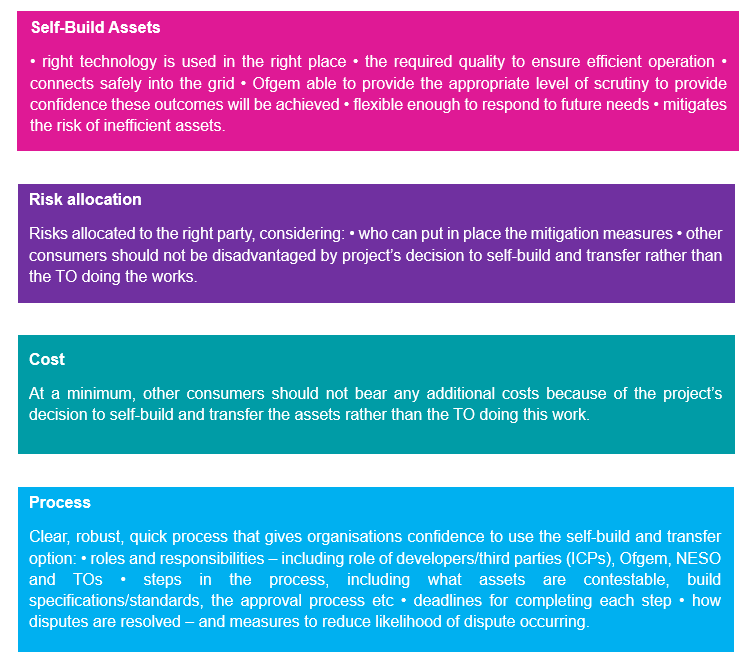
Ofgem also indicates in the Connect Update that “good” might be achieved through measures such as the use of Pre-Approval of Solutions by Engineering (PASE) to mitigate the risk of sub-standard and inefficient assets; establishing a clear process for self-build and transfer to maximise potential benefits and manage the key risks; and providing clarity on how these assets would be classified for charging purposes, including whether a standard price list may be needed for any assets that will not be charged to the connecting customer.
Similar to the Ownership update, we expect that the majority of stakeholders will welcome these developments with open arms. Looking at some of the ideas as to what “good” looks like and the measures to achieve “good”, however, it is clear that there are a number of thorny issues which industry will need to work through. These include the standards that TOs and iTOs are held to, potential second-comer principles, and the adoption process, which is commonly cited as being less smooth and efficient than it should be at distribution and transmission level. Industry will also need to strike the correct balance between speed of connection and energisation on the one hand and preserving a robust and reliable network on the other.
CONNECT OPERATE
In the Demand Call for Evidence, Ofgem noted the opportunity for large demand customers to contribute towards consumer-led flexibility, with potential options including ramped and non-firm connections and a wider requirement and/or incentive regime in relation to flexible demand. The Demand Call for Evidence also highlighted that such measures may also enable the faster connection of large demand projects (particularly data centres).
The Connect Update provides an update on this, with Ofgem, Government and NESO considering the following flexibility measures (which we explore in more detail below):
However, the Connect Update acknowledges that any potential interventions will need to be assessed against a trilemma of system needs, data centre operational needs and data centre investability needs.
Alternative Connection Agreements
As alluded to above, Ofgem sought feedback in the Call for Evidence on the practical blockers to the uptake of flexible, non-firm, and phased (ramped) connection agreements. The feedback Ofgem received (based on the content of the Connect Update) is that:
Taking into account this feedback, Ofgem provides an update in the Connect Update on the steps it will take including:
Voluntary Flex Services
Ofgem acknowledges in the Connect Update that the ability to operate a data centre flexibly is dependent on that data centre’s use and underlying business model. However, it also notes that flexible operation of a data centre can be designed as it develops, with data centre developers potentially being willing to do this if it enables an earlier connection.
Ofgem goes on to indicate in the Connect Update that the next steps in identifying the opportunity for voluntary flex services are:
Operational Control Measures
Ofgem has indicated that it will continue to consider whether backstop operational control measures (such as mandatory curtailment) should be introduced into the industry codes to reduce uncertainty around the modelling and forecasting of data centre demand and therefore potentially facilitate an accelerated connection of data centre projects (and the connection of a greater number of projects).
Ofgem notes though the key message from data centre operators and trade associations that any backstop operational controls present challenges to different data centre business models and overall investability.
Reflecting this, Ofgem indicates that it will:
CLOSING REMARKS
The Connect Update represents an important policy update to all those involved in the electricity and data centre sectors.
A greater right to self-build and own and/or transfer electricity transmission assets, together with an iTO regime, has been on the wish list for developers, iDNOs and those looking at investment opportunities in the wider electricity network sector for many years. As a result, confirmation by Ofgem that it will look to facilitate all of these developments will, we expect, be exceedingly well received. We nevertheless anticipate that a large number of organisations may wish to provide feedback to Ofgem on these proposals before any formal consultation is published later this year, with some of this feedback potentially having more of an investor/funder focus than Ofgem expects, given the wider opportunities arising from any iTO regime and its interaction with CATO policy developments.
We also anticipate that stakeholders will welcome Ofgem’s recognition that any targeted policy interventions relating to grid connection agreements and flexible demand for data centres must be assessed against the trilemma of system requirements, data centre operational needs and data centre investability. However, Ofgem’s stated intention to continue exploring whether mandatory backstop operational control measures (such as mandatory curtailment) should be implemented, is likely to concern all those parties developing data centre projects (and potentially owners of operational data centre projects, contingent on whether such measures may also be applied to operational projects at the time of implementation).
More generally, the speed at which these measures are implemented will be crucial if the UK is to reform the current demand connection queue and unlock significant data centre and demand projects at a time of material market demand. Many affected stakeholders may therefore want to push Ofgem, Government, NESO and others to accelerate the consultation and implementation timetable.
Burges Salmon has extensive experience advising clients on all aspects of the delivery of GB data centres, as well as on the numerous opportunities that are arising in the GB electricity network sector as result of regulatory reforms. If you would like to discuss how any of these potential reforms may affect you and/or create an investment opportunity, please do get in touch with Alec Whiter or James Phillips.
This article was written by Alec Whiter, with assistance from Alice Veloso.
 Thought leadership
13 October 2026
/Passle/5d9604688cb6230bac62c2d0/SearchServiceImages/2026-10-13-13-19-48-365-6ace2ff48209d8ca9829f759.jpg)

Thought leadership
13 October 2026
/Passle/5d9604688cb6230bac62c2d0/SearchServiceImages/2026-10-12-20-57-46-955-6acd49ca3a2af6187605cf2d.jpg)
Thought leadership
7 October 2026
/Passle/5d9604688cb6230bac62c2d0/SearchServiceImages/2026-10-07-13-24-03-610-6ac647f33724c91c5285c5bc.jpg)

Legal updates
1 October 2026

Thought leadership
1 October 2026
/Passle/5d9604688cb6230bac62c2d0/SearchServiceImages/2026-09-17-16-44-01-145-6aac18d13163f6587eb96e08.jpg)
Thought leadership
22 September 2026
/Passle/5d9604688cb6230bac62c2d0/SearchServiceImages/2026-09-22-12-58-29-767-6ab27b750e64863551deb684.jpg)

Legal updates
18 September 2026

Want more Burges Salmon content? Add us as a preferred source on Google to your favourites list for content and news you can trust.
Update your preferred sourcesBe sure to follow us on LinkedIn and stay up to date with all the latest from Burges Salmon.
Follow us