

 Thought Leadership
Robotics Law in the UK: The Key Legal Issues Facing Robotics Developers

23 Nov 2026
7 min read
This website will offer limited functionality in this browser. We only support the recent versions of major browsers like Chrome, Firefox, Safari, and Edge.
Thought Leadership
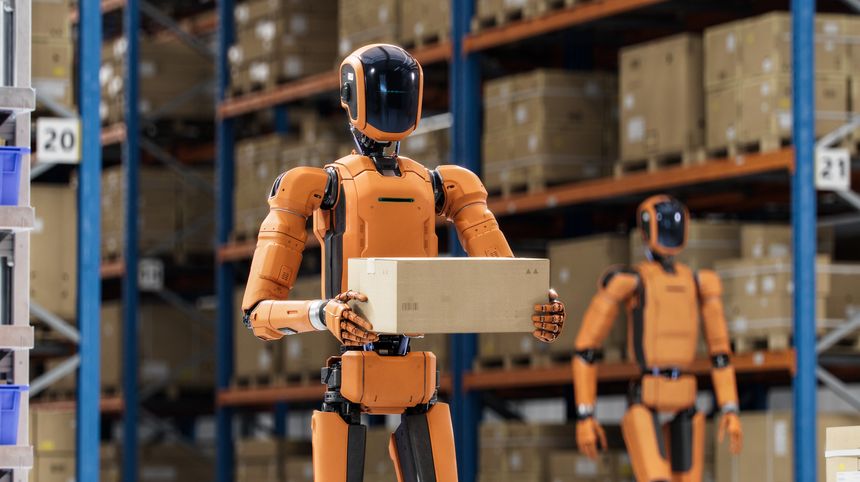


Robots are leaving the factory floor. Thanks to advances in AI, they are now finding their way into warehouses, hospitals, farms and building sites, and humanoids are no longer just a trade-show curiosity: GXO, the world’s largest pure-play contract logistics provider, recently announced plans to scale up trials of humanoids from AI-powered robotics company Apptronik towards as many as 1,000 robots (see here), London-based Humanoid is preparing to mass-produce its robots with a number of household name brands (see here) and a humanoid robot has already worked on a live UK building site (see here). There are numerous other examples.
For the businesses building these machines, the legal questions are multiplying just as quickly and are becoming no less easy to navigate.
How has AI Made Robots Different Today?
AI has changed the way in which robots can learn and autonomously adapt to carry out tasks based on their own understanding of their role and surrounding environment. How AI-driven robots learn today is increasingly through Vision-Language-Action (VLA) models. VLA processes three features in the robot:
The significance of this learning model is that it enables robots to be deployed autonomously by being able to react to variations in physical surroundings and instructions. From a legal perspective, the technology raises serious questions and in many respects, similar questions to those currently facing AI agents. Who is liable if a robot damages property or a person? Who owns the data for training a robot and what protections are in place? For manufacturers, suppliers and operators of AI-driven robots, these questions need answering.
What is the Regulatory Landscape and How Can Businesses Stay Compliant?
There is no single “robotics law” in the UK. Instead, robots are caught by a patchwork of general rules, in addition to sector-specific regulation. It is also worth noting that the UK has no dedicated AI law. That adds another layer of fragmentation for those AI-powered robots or physical AI, which is why sector-specific advice matters.
The starting point is knowing your role. Manufacturers carry the heaviest burden, but importers, distributors, integrators and users all have duties, and anyone who retrains or substantially modifies a robot may find they are treated as a manufacturer.
Product Safety and Liability: Who Pays When Things Go Wrong?
Before a robot can be sold in the UK, it must meet both general and mandatory safety requirements (the latter include, for example, those on machinery, electronics, radio equipment, batteries and others). This means, amongst other things, a documented risk assessment, a technical file and the relevant safety marking. If a defective robot injures someone, the producer can be liable. Whilst there are open questions as to how product liability law applies to software updates and behaviour a robot has learned for itself, law in the UK is reforming to deal with cyber-physical products and AI systems (as a product and as embedded in other products) as it has in the EU.
Health and Safety: Safe Robots, Safe Systems
Where robots work alongside or may affect people, health and safety law is a key pillar. Risks must be reduced so far as is reasonably practicable. Falling short is a criminal offence even if nobody gets hurt. Fines are linked to turnover and seriousness of breach. For example, an electrical manufacturer was recently fined £4m after an employee suffered serious injuries from a crush by forklift machinery (see here). Responsibilities cannot be handed off to someone else by contract. Those deploying robots will therefore need to implement effective safety measures and safety systems of work, based on carefully considered risk assessments for both deployment of the technology and its place within (and interactions with) the wider socio-technical workplace. The HSE (Regulator) is currently doing much work in this space (see here).
Data and Cyber Security: Robots that See and Hear
Robots trained with VLA models are constantly recording the people around them. Even data that looks anonymous, such as location or movement patterns, can identify individuals and reveal sensitive details about them. Data protection compliance under the UK GDPR and the Data Protection Act 2018, both recently updated by the Data (Use and Access) Act 2025, therefore needs to be front of mind.
With regulators aligning regulatory oversight over agentic AI (see our article here), physical AI will need similar attention. Developers need to work out who controls that data across what is often a long supply chain, put proper contracts in place with processors, build privacy into the design from the start, and take particular care with anything biometric or health-related. Attention will also need to be given to the use of robots by children (e.g., robotic toys); we have already recently seen mistakes made by the manufacturer of an AI plush toy: the toys allegedly discussed topics of suicide, despite being marketed to children as young as three (see here). Accordingly, many robots will also need incident data recorders to show what went wrong, which raises its own questions about who can access that data. Cyber security matters just as much. A hacked robot is not just a data breach but a physical hazard. Developers will need to lean on a mix of data protection, health and safety and industry standards, especially as the UK intends to extend its cyber rules to cover more technology suppliers (see here).
Intellectual Property: Who Owns the Robot’s Brain?
The models that drive modern robots are often trained on vast amounts of video, sensor and demonstration data, and investors have taken notice. How that data can lawfully be used is far less settled. The UK rules on training AI with other people’s content remain uncertain, and in March 2026 the government shelved its preferred reform to gather more evidence. Getty Images v Stability AI (see our article here) showed just how complex and high stakes these disputes can be, and the key questions are now heading to appeal. Robotics developers relying on third-party data could find themselves facing similar claims: rights in training data, models and the skills a robot learns need to be pinned down early in supply contracts.
Why Does Compliance with Sector-Specific Regulations Still Matter?
Whatever its software, a robot is still a medical device in a hospital, a vehicle on a public road, and work equipment in a factory, and each sector brings its own rules. Whilst there are no limits to the sectors in which robots can be deployed, the following sectors are where robots are increasingly being used:
Future Regulation
Some of the biggest changes are coming from Brussels. From January 2027, new EU machinery rules will require robots whose safety functions rely on machine learning to be independently assessed rather than self-certified, and the UK government has said it plans to follow a similar path. The EU AI Act is also due to treat functions such as collision avoidance and human detection as “high-risk” and so, robotics developers looking to operate internationally will need to keep these rules in mind.
Whilst the UK does not yet have a single AI law, the Joint Committee on Human Rights has called for an AI-specific legal framework (see our article here). Until such a framework is in place, regulators are far from standing still. The MHRA, for instance, is due to publish draft guidance by December 2026 on medical devices that change as they learn (see here), of particular importance for those building surgical or care robots. In addition, the Law Commission is asking whether software and AI should be treated as “products” when things go wrong (see here). Its consultation closes on 14 January 2027, so there is still time for robotics businesses to have their say.
It’s fair to say that we will be seeing more, not less, regulatory and legislative intervention impacting this field.
What it Means for Robotics Businesses
Regulation is often seen as a brake on innovation. For robotics, it is fast becoming a ticket to market and one of the best defences against a claim. With so much changing in 2027, now is a good time to take stock: be clear about your role and your supply chain, document your safety case, and make sure you own the IP and data your robots depend on.
If you would like to discuss any of the issues raised in this article, please contact Martin Cook, Ben Randall or another member of our Technology and AI team.
This article was written by Ben Randall, Rufus Darwall and Martin Cook.
 Thought leadership
23 November 2026



Thought leadership
19 November 2026

Thought leadership
19 November 2026


Thought leadership
18 November 2026




Want more Burges Salmon content? Add us as a preferred source on Google to your favourites list for content and news you can trust.
Update your preferred sourcesBe sure to follow us on LinkedIn and stay up to date with all the latest from Burges Salmon.
Follow us