

 Thought Leadership
Contracts for Difference Allocation Round 8 (AR8): What we know so far

10 Jun 2026
13 min read
This website will offer limited functionality in this browser. We only support the recent versions of major browsers like Chrome, Firefox, Safari, and Edge.
Thought Leadership
/Passle/5d9604688cb6230bac62c2d0/SearchServiceImages/2026-06-10-17-51-17-984-6a29a415bb6b0484725362fd.jpg)


In May and June 2026, the Government published a number of documents in relation to Contracts for Difference Allocation Round 8 (AR8). These documents together provide interested parties with an overview of some of the likely key features and changes that will apply in AR8. This article sets out an overview of these key features and changes.
AR8 Indicative Timings
On 27 May 2026 the likely AR8 timeline was published. Key indicative dates include:
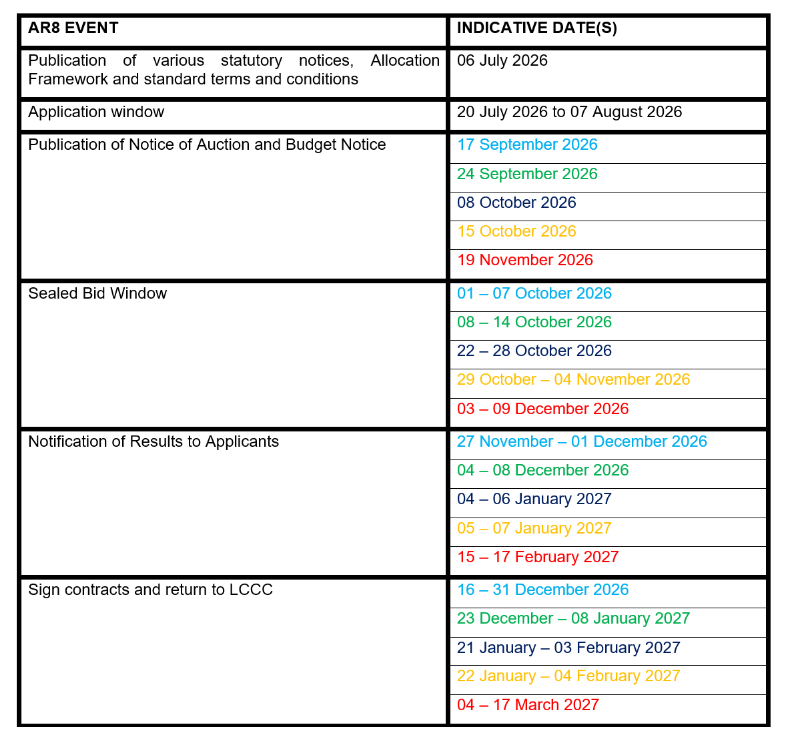
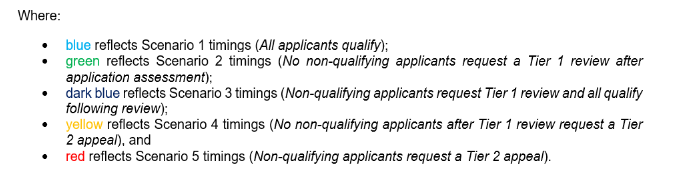
For wider context, Tier 2 appeals were requested in AR5, AR6 and AR7. However, various amendments have been proposed for AR8 which are intended to cut down the number of Tier 2 appeals and reduce the ability of appeals to hold up the auction timetable (please see below for further commentary on this).
AR8 Provisional Delivery Years and Eligible Technologies
On 08 May 2026 the AR8 Contracts For Difference (Allocation) Regulations 2014 Exemptions Request Notice was published. This contains the following provisional eligible technologies and delivery years for AR8, noting that the final decision on these matters will likely be confirmed on 06 July 2026.
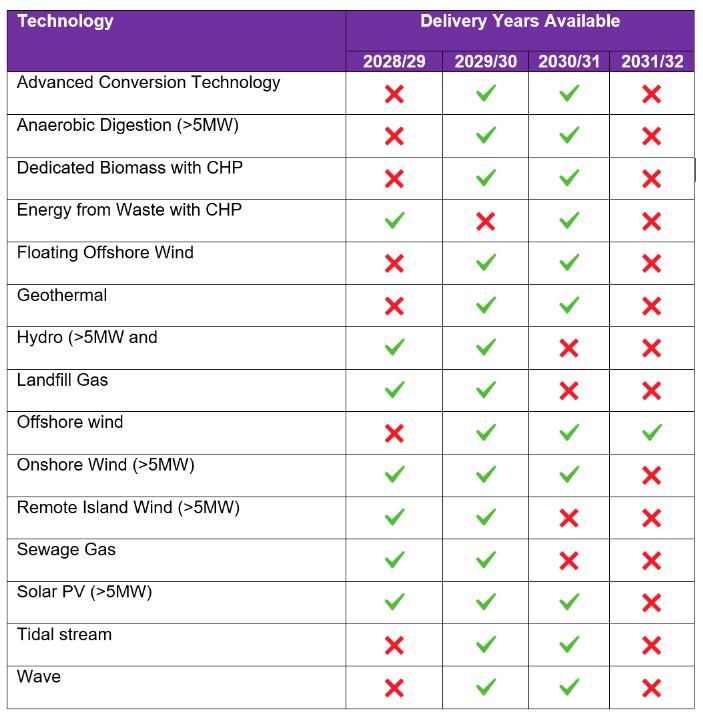
For wider context, the Target Commissioning Date selected by an Applicant in relation to a proposed CfD Unit has to (among other things) be a date on or after the indicative connection date for the relevant project as set out in its connection agreement and has to occur on or before the last day of the last Delivery Year open to that project (taking into account the technology of that project). In addition, the earliest date that the Target Commissioning Window can commence in relation to a project is such that the final day of that Target Commissioning Window (taking into account the technology specific Target Commissioning Window length for that project) falls on the first day of the applicable Delivery Year in which the nominated Target Commissioning Date occurs.
AR8 Eligibility Requirements
The draft AR8 Contract Allocation Framework was published in June 2026 (the “Allocation Framework”), together with an indicative Schedule 5 setting out the Application Checks that the Delivery Body will carry out, with the contents intended to reflect the general requirements in the Contracts for Difference (Allocation) Regulations 2014 (the “Allocation Regulations”) and any additional requirements set out in the main body of the Allocation Framework.
Most of the proposed Schedule 5 checks will be familiar to all that participated in previous CfD allocation rounds, but key proposed eligibility changes and clarifications for AR8 include:
Grid Connection Offers
For AR8, an Applicant will be required to provide to NESO (as Delivery Body) either:
The Government has also helpfully confirmed in its response to the proposed refinements for AR8 and future allocation rounds that:
“where an applicant has relied on their pre-G2tWQ connection agreement to satisfy eligibility criteria, there is no requirement on the applicant to provide the new G2tWQ connection offer/agreement to the Delivery Body at a later stage within the Contract Allocation Process. However, successful applicants may need to provide their new G2tWQ connection offer/agreement to the LCCC after CfD contract signature for other contractual reasons”.
Low Carbon Contracts Company Ltd (“LCCC”) has separately issued for AR8 another confirmation (in relation to NESO’s Grid Connection Reform) that:
“where NESO moves a project’s grid connection date as a result of the NESO Grid Connection Reform programme and that causes a delay to the project, such event is capable of constituting a grid delay for the purposes of the CfD.
This means that generators will be able to apply for extensions to any contractual dates impacted by their connection date moving provided they can demonstrate delay to their project. However, any such application for contractual relief will still need to satisfy all the relevant contractual requirements, including the Generator and its Representatives using reasonable endeavours to mitigate the effects of such delay.”
As such, developers do now have a degree of certainty as to how NESO and LCCC will approach the impact of connections reform on projects. However, the proposed AR8 Standard Terms and Conditions (the “Standard Terms”) still mean that a successful generator has to take various actions to push back relevant delivery and milestone dates and early and continued dialogue with LCCC will be essential in the event of delay caused by connections reform.
Surrendered Capacity
Continuing the principle that was implemented in AR7, generation capacity that was surrendered from a CfD awarded in a prior allocation round (through the contractual right to adjust the Installed Capacity Estimate) will be excluded from AR8.
This reflects the original policy intention behind the “permitted reduction” and “final installed capacity” mechanisms, which were designed to allow developers to respond to evolving construction and delivery circumstances, rather than to facilitate the recycling of capacity into later auctions for other reasons. Applicants can therefore no longer circumvent an uncompetitive CfD strike price by seeking to withdraw capacity and rebid for a more favourable price in a later round.
Planning Permissions
The Allocation Framework indicates that the Government is minded to expand the supplemental evidence requirements in respect of planning consents where the deadline (in a planning permission submitted as part of the auction process) by which construction must have commenced has passed and/or the expiration date has lapsed.
The draft Schedule 5 provides that:
“Where the deadline to commence construction in the Applicable Planning Consents has expired, the Applicant must demonstrate an extension has been granted by the issuing authority. The consent term, by which it limits the consented operational life of the project, is not acceptable evidence for this requirement.”
Further, Applicants must provide to NESO:
if an extension has been granted but work has not started, evidence of the relevant issuing authority granting an extension; or
if works have started, acknowledgment by the issuing authority of this which may include (without limitation) a signed letter or evidence of an extension.
Taking into account the above, developers may want to carry out a review of their planning permissions with a focus on expiration dates and construction deadlines, and if these have passed (and taking into account the approach that Ofgem and NESO took in AR7) liaise with NESO to determine what the exact evidential requirements are (noting that it is not clear based on the draft Schedule 5 whether an extension is always required, or whether planning authority acknowledgment that works have started is sufficient) and contingent on the response, ensure that they obtain the required evidence / extension and provide it to NESO.
Non-Eligibility, Appeals and Pending Bids
A consistent complaint from hopeful CfD auction participants across multiple allocation rounds has been the inability for NESO to take a pragmatic approach to considering additional documentation / information which was alluded to in an application / part provided to NESO, but that was not provided in full to NESO by the deadline (for whatever reason). By way of example, there were 35 appeals in AR7, with many of these related to documentary / evidence issues and with it being clear from the facts relating to a number of these appeals that Applicants simply provided (in error) the wrong documentation and/or only part of the right documentation.
The proposed change to Regulation 20 of the Allocation Regulations and the introduction of new Rules 8.3 and 8.4 to the Allocation Framework will therefore be welcomed by many as they provide that NESO may, as part of any Non-Qualification Review or Amended Determination Review, take into account Additional Information or Documentary Evidence submitted by the Applicant if:
“(a) the relevant Application that is the subject of the review contained a Non-Material Error or Omission; and
(b) the Additional Information or Documentary Evidence is capable of rectifying the Non-Material Error or Omission”
The proposed definition of “Non-Material Error or Omission” and “Additional Information or Documentary Evidence” in the Allocation Framework does though allow NESO a large degree of discretion regarding what amounts to a “Non-Material Error or Omission” and limits Applicants to only being able to provide additional documentation that: (a) was not provided by the Applicant to NESO with its Application; (b) existed at the time that the Applicant submitted its Application; and (c) was in the Applicant’s possession at the time that the Applicant submitted its Application.
Applicants will therefore want to commit resource to finalising and obtaining any final project contracts / consents, completing application forms, pulling together the relevant documentary evidence and cross-checking details to try and avoid any Non-Qualification Determination.
The Allocation Framework also introduces a new Rule 9 which creates a right for NESO to issue a new or amended Non-Qualification Determination to Applicants who have received a determination notice under Regulation 19 following NESO’s assessment of their Application. However, the issuing of such a determination is subject to defined timing restrictions and the expectation is that such will be a very rare occurrence.
The Government has stated separately in its response to the consultation on Legislative proposals on proposed refinements for AR8 and future rounds that:
Auction Design
Clearing Price Competition
The Allocation Framework includes a new Rule 23 that is intended to allow the Secretary of State to apply separate clearing prices absent of any minima or maxima to technologies in CfD auctions based on the following categories:
The stated rationale for this intervention is the desire to prevent overcompensation for some projects through them receiving a clearing price that amounts to a significant premium on their actual costs taking into account the pay as clear auction mechanism of the CfD auction and the believed material difference in cost profile for different generating technologies.
The practical significance of this is that it makes the allocation process more granular and potentially harder for bidders to anticipate clearing outcomes (particularly taking into account the proposed increased to the sealed-bid and anonymised Bid Information the Secretary of State will have access to and the limitation on Flexible Bids) (please see the section below).
Widening Secretary of State Access to Anonymised Sealed Bids & Bid Requirements
The Allocation Framework will, if implemented, extend the sealed-bid and anonymised Bid Information regime to solar PV, onshore wind and remote island wind projects (whilst maintaining its application to fixed bottom offshore wind projects).
As a result, NESO will be required to send anonymised Bid Information (defined widely under Regulation 54 of the Allocation Regulations) for bids that involve those referenced technologies, with the Government’s consultation response stating that it will only view anonymised bids that are above the relevant budget.
Any Applicant in respect of a solar PV, onshore wind, remote island wind and/or fixed bottom offshore wind project will also, as a result of proposed Rule 13.3 in the Allocation Framework, be limited to only making one sealed bid in an auction.
This means that affected Applicants are not permitted to submit Flexible Bids, and with their one sealed bid also needing to comply with the principles that:
the Target Commissioning Date in the bid can be no earlier than 1st April in the Delivery Year specified in the Applicant’s Original Application and no later than 31st March of the last applicable Delivery Year; and
the capacity of the CfD Unit, cannot exceed the Initial Installed Capacity Estimate provided in the Applicant’s Original Application, but can be less than the estimate provided at application stage.
The stated rationale for these changes is to help reduce the risk of budget underspends from the increasing participation of significantly larger solar projects in CfD auctions and the the risk of just missing out on good-value solar and onshore wind projects that could deliver for 2030, whilst also maintaining competitive tension.
Sealed Bids
The Allocation Framework also indicates that the Government is intending to reverse the previous approach that if an Applicant did not submit a sealed bid in a CfD auction they were treated as having bid at the Administrative Strike Price. Instead, Rule 16.3 provides that, if an Applicant does not submit a sealed bid on or before the Submission Closing Date in relation to an auction, that Applicant’s Application will be treated as withdrawn.
Notable CfD Standard Terms and Conditions Amendments
Hybrid Metering
It has been confirmed that generators that hold an AR8 CfD will be able to take advantage of hybrid metering arrangements. This represents a departure from the requirement to date for non-private wire generators to ensure that the output of their CfD Unit is measured exclusively at the Balancing Mechanism Unit (BMU) boundary. Now, sub-BMU metering data may be used solely for CfD settlement purposes, with a wider BMU permitted to comprise of additional generation infrastructure (but only if that generation infrastructure is of the same technology as the CfD Unit and subject to other restrictions).
As such, combined generation and storage under one BMU is still not permitted. This change will be welcomed by many, but may be seen by some as a missed opportunity to facilitate the real value of co-located storage and generation assets (albeit wider changes to industry codes may also be required).
Floating Offshore Wind
The Standard Terms are proposed to be amended for floating offshore wind projects so that there is an extended 24-month long stop period for new projects, with the Operational Condition Precedent capacity requirement being amended to 85% of the Installed Capacity Estimate (rather than 95%). These amendments bring the terms that apply to floating offshore wind projects closer to fixed-bottom offshore wind terms, reflecting the expectations of larger projects, weather sensitivity, port constraints and supply-chain risk.
Deepwater Offshore Wind
A new “Deepwater Offshore Wind” category of projects is set to be introduced for AR8 to avoid the CfD technology definitions themselves becoming a barrier to innovative deepwater substructures that are neither conventional “fixed-bottom” nor legally “floating” under the existing definition. Applicants looking to benefit from the revised definition will be required to provide planning consent material indicating that deepwater foundations are permitted, a colour-coded depth chart, and a signed director’s declaration confirming that the project will satisfy other certain conditions (including the 50-metre depth threshold and the geometric exclusions in the definition).
Unilateral Commercial Operations Notice (UCON)
The Government has confirmed that it will amend the Standard Terms to strengthen the operation of the UCON provisions by introducing measures that enable LCCC to obtain near real-time metering information for distribution-connected generators.
Indexation
The “Base Year CPI” definition in the Standard Terms will be amended to be the simple arithmetic mean of all monthly values of CPI for 2024 (rather than the value of CPI for October 2023 which in effect was the “Base Year CPI” for AR7 CfDs). The consumer price inflation time series published by the Office for National Statistics on 20 May 2026 indicates that the 2024 value is 133.9. This is as against the October 2023 CPI value of 132.
Commentary
Taken as a whole, the proposed changes to the Allocation Framework, the Allocation Regulations and the Standard Terms indicate that Government is intending to align in a pragmatic way AR8 with the wider connections reform agenda, be more exacting as to what amounts to an eligible application, and potentially intervene in a more granular way with regards auction design and outcomes and management of any awarded CfD.
If you have any questions or need further clarification in relation to AR8, please get in touch with Alec Whiter, Emma Andrews, James Phillips, Nick Churchward or Ross Fairley of the Burges Salmon energy team.
This article was written by Alec Whiter and Hal Parkes.
 Legal updates
22 September 2026

Thought leadership
22 September 2026
/Passle/5d9604688cb6230bac62c2d0/SearchServiceImages/2026-09-22-12-58-29-767-6ab27b750e64863551deb684.jpg)
Thought leadership
22 September 2026
/Passle/5d9604688cb6230bac62c2d0/SearchServiceImages/2026-09-04-15-50-36-026-6a9ae8cc9a3310b0baa4f076.jpg)

Legal updates
18 September 2026


Thought leadership
11 September 2026
/Passle/5d9604688cb6230bac62c2d0/SearchServiceImages/2026-09-11-15-37-34-289-6aa4203e68316c73ea5a2624.jpg)
Thought leadership
4 September 2026
/Passle/5d9604688cb6230bac62c2d0/SearchServiceImages/2026-09-04-10-41-42-841-6a9aa0669a3310b0baa411fa.jpg)
/Passle/5d9604688cb6230bac62c2d0/SearchServiceImages/2026-09-04-07-25-24-151-6a9a72643a6dbbc3cdd60d29.jpg)
Thought leadership
2 September 2026
/Passle/5d9604688cb6230bac62c2d0/SearchServiceImages/2026-09-02-11-09-08-138-6a9803d48c3102bcdcd4cdd3.jpg)
Want more Burges Salmon content? Add us as a preferred source on Google to your favourites list for content and news you can trust.
Update your preferred sourcesBe sure to follow us on LinkedIn and stay up to date with all the latest from Burges Salmon.
Follow us