

 Legal updates
A guide for Americans moving to the UK

9 Nov 2026
12 min read
This website will offer limited functionality in this browser. We only support the recent versions of major browsers like Chrome, Firefox, Safari, and Edge.
Legal updates



The UK has a favourable tax regime for new arrivals, including individuals moving from the US, and the treaties between the two jurisdictions can make the UK a very attractive destination for Americans.
Indeed, with appropriate planning in place, US citizens can find that moving to the UK has little to no impact on their overall tax burden in their first few years of UK residence.
That “appropriate planning” generally involves taking considerable care to avoid double taxation. US citizens are subject to US taxes on their worldwide income and capital gains, and estate tax on their worldwide assets, regardless of where they live. The UK generally taxes those who are resident in the UK.
As such, US citizens moving to the UK can find themselves navigating taxes in both jurisdictions.
In this guide we discuss some of the key issues for Americans to consider before (and when) moving to the UK.
Important points include:
In an ideal world, a US person considering a move to the UK would take both US and UK advice before relocating. As part of this they should give thought to the precise timing of any move.
The US tax year is a calendar year whereas the UK tax year runs from 6 April one year to 5 April the next. This mismatch requires careful management so as to make the best use of tax reliefs and credits.
A common issue is that moving to the UK part of the way through a tax year can, by default, trigger UK tax exposure from the beginning of that (UK) tax year. By way of example, a move in October 2027 could trigger UK tax exposure from 6 April 2027.
However, if a person’s affairs are arranged appropriately, it is often possible to “split” the tax year so that UK tax exposure only begins in earnest after the actual physical move.
More information on the UK’s residency tests can be found here: Residence, Long-Term Residence and Domicile: what do they mean? – Burges Salmon
As is explained in more detail elsewhere in this article, those moving to the UK from the US should take advice on various possible planning steps before relocating:
Those moving to the UK can generally enjoy:
This can be summarised as follows:
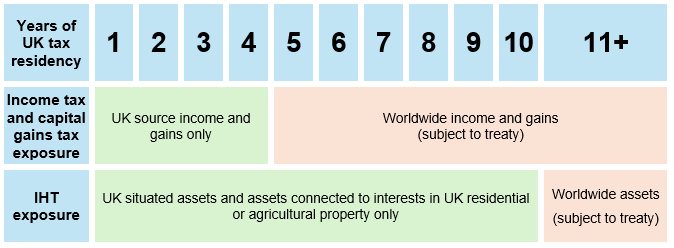
These regimes can reduce the short to medium-term tax impact of a move to the UK.
Even if US persons intend to stay for longer, they provide valuable planning windows in which tax affairs can be re-arranged at relatively low cost if necessary.
All that being said, and whilst straightforward in principle, making the most of these regimes in practice requires expert advice. Just by way of example, the FIG regime may not shield investments held via corporate entities and comes with significant compliance burdens.
More detail on the UK’s special regimes for new arrivals can be found here (The UK’s new rules for international individuals and their structures: a high level summary – Burges Salmon) and here (The UK’s new tax regime for internationally connected individuals and their structures (as of 25 June 2025) – Burges Salmon).
One issue which often surprises people is the complexity that can arise when considering the taxation of investments held by US persons who are resident in the UK.
This is because tax advantaged investments in one country may not have any benefits in the other, whilst both jurisdictions operate a number of anti-avoidance rules which can impose high effective tax rates if triggered.
For example, many US mutual funds will be treated as “offshore non-reporting funds” in the UK. The disposal of these can trigger UK income tax (rather than capital gains tax) rates regardless of the nature of the underlying investments.
Conversely, many funds from outside of the US will be treated as “passive foreign investment companies” or PFICs for US tax purposes, triggering very high US taxation.
The combination of these rules means that US citizens who are resident in the UK have to be very careful as to the types of funds which they hold. In some cases, it may be sensible to avoid funds and to hold line-item stocks instead. The issues are manageable with good tax advice but ignoring them can result in punitive taxation which may wipe out a large percentage of gross profits.
Furthermore, favourable tax regimes in one country rarely offer any assistance in the other. “ISAs” (individual savings accounts) in the UK are a straightforward demonstration of this. They allow cash or investments to grow without any UK income tax or capital gains tax exposure but they don’t have any impact in the US, meaning that income and gains realised within such accounts are still likely to be fully exposed to tax there.
The differences in the two jurisdiction’s tax regimes also need to be borne in mind when looking at insurance products. For instance, the UK operates an anti-avoidance regime known as the “personal portfolio bonds” rules which can apply penal tax rates to insurance products which have an element of investment (as many US policies do).
It is also common to write insurance policies into trust, in which case the trust needs to be in a particular form if it is to achieve the desired result in both countries and thought has to be given as to how the payment of premiums will be taxed in each. Each of the UK and the US have reliefs which can allow individuals to pay the premiums for policies held in trust without triggering immediate taxation but the criteria differ.
More information on life insurance for US persons in the UK can be found in this article.
Common estate planning tools in the UK may cause issues for US persons, just as common estate planning vehicles in the US might trigger tax for UK residents.
For example, “family investment companies” are increasingly prevalent in the UK (see our article here) but often fall foul of US PFIC rules.
Conversely, many Americans will use a revocable trust as their principal estate planning tool. In the US these trusts are generally tax neutral with the assets being treated as if they were still owned by the “grantor” of the trust (the grantor is usually the individual who transferred the assets to the trust). However, in the UK they can trigger a number of anti-avoidance rules which result in material tax liabilities. If not managed correctly these can result in double taxation between the two countries (Trusts in the context of UK/US planning – Burges Salmon).
Similarly, LLCs are often look-through in the US but taxed as opaque entities in the UK, which can also lead to double taxation if care is not taken to address the point.
Furthermore, a US person moving to the UK could theoretically pull structures they are connected to (including trusts and LLCs) into the UK tax net alongside the individual. This could create additional tax exposure and compliance obligations.
The key to avoiding these problems is to have any planning reviewed by both UK and US advisers and to engage those who have experience of navigating the complexities of US/UK arrangements.
Just one example of the potential solutions is a family investment partnership, which will often be taxed in the same way in both jurisdictions and so can make more straightforward use of tax credits (Family Investment Partnerships – what you need to know).
There are a number of important differences in how the US and the UK tax real estate.
One is that the US only allows a limited exemption of $250,000 for (federal) capital gains tax on an individual’s main residence whereas in the UK a main residence can be entirely exempt from UK capital gains tax.
In addition, for US tax purposes any currency gains on a UK mortgage can be taxed as ordinary income.
One planning option that can be used to deal with these issues is to put a UK property in the name of a non-US spouse (if there is one), as shown in the diagram below:

If that is not possible, then an interest-only mortgage can reduce the impact of this issue, or it may be preferable to rent or purchase for cash.
In summary, thought needs to be given as to how property is acquired in the UK.
It should not be assumed that a pre-nuptial agreement entered into in the US will be fully effective in the UK, nor vice-versa.
For this reason, any pre-existing agreements should be reviewed as part of the relocation, and any new agreements to be entered into following the move should take account of the law in both jurisdictions.
A US Will can be effective in the UK and vice versa. However, the different tax regimes on death mean that great care needs to be taken when drafting Wills for US persons in the UK.
In particular, steps should generally be taken to ensure that, to the extent UK inheritance tax and US estate tax will be triggered at all, they arise at the same time and in relation to the same assets. This allows tax credits to be used to avoid double taxation.
Expert assistance is crucial to navigate the potential minefield here and ensure that loved ones benefit from as much of the estate as possible.
Capacity issues also need to be considered. US capacity documents are unlikely to be accepted in the UK and vice versa. As such, “lasting powers of attorney” should usually be put in place in the UK to ensure that an appropriate person can access financial assets, and take healthcare decisions, if capacity is lost. These do not replace any US capacity documents (such as durable powers of attorney) but work alongside them.
Structures that make complete sense from a purely domestic US perspective often have counterintuitive and punitive consequences once the UK angle is layered on top.
Whilst the UK’s special tax regimes for new arrivals can mitigate the impact to some extent, there is no substitute for taking expert advice. The Burges Salmon international tax team has a wealth of experience in this area and is well placed to assist US persons with their estate planning in the UK.



 Thought leadership
3 November 2026

Thought leadership
29 October 2026



Thought leadership
22 October 2026

Podcasts
15 October 2026 • 10 min read


Want more Burges Salmon content? Add us as a preferred source on Google to your favourites list for content and news you can trust.
Update your preferred sourcesBe sure to follow us on LinkedIn and stay up to date with all the latest from Burges Salmon.
Follow us